

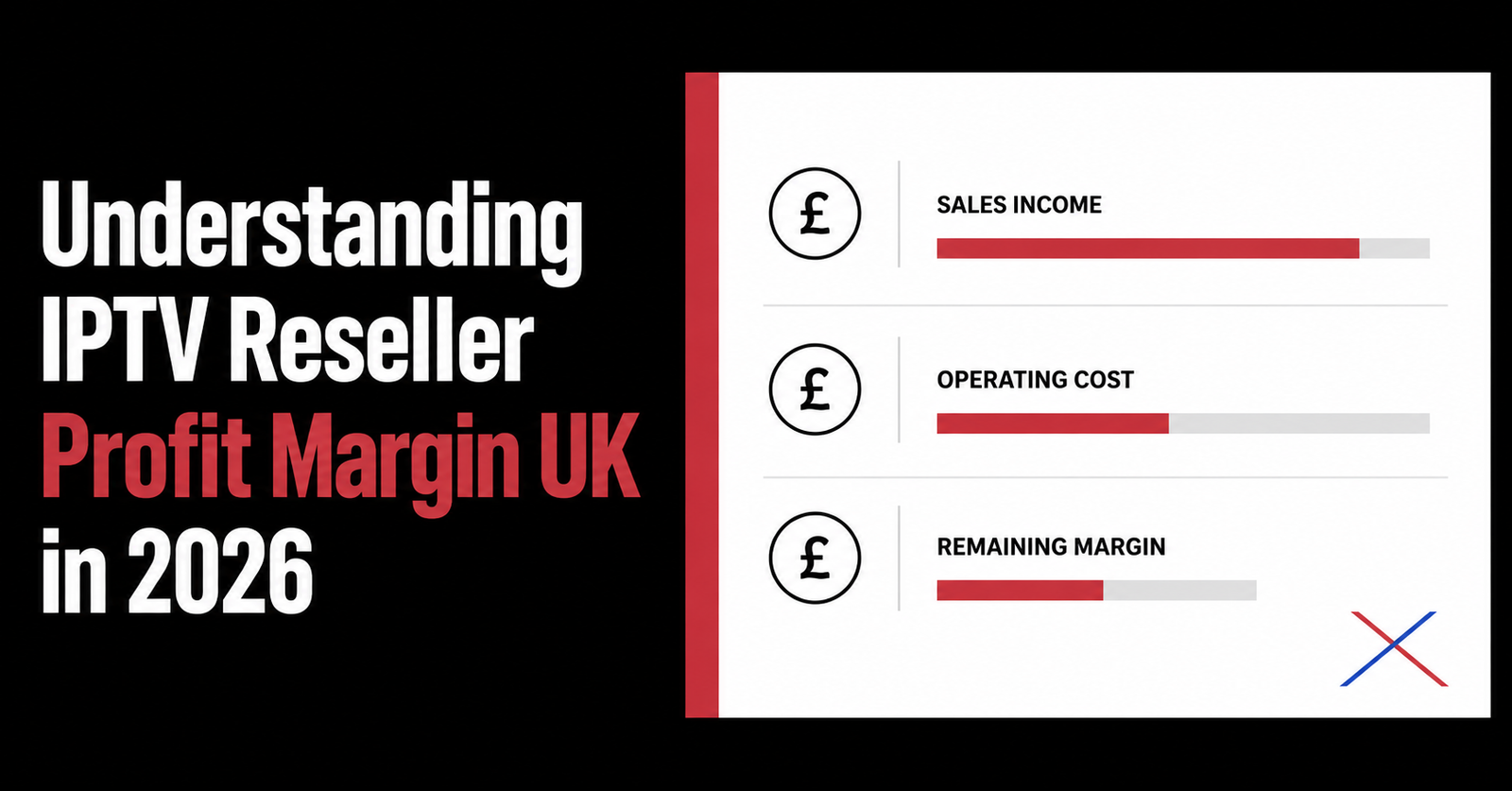
IPTV Reseller Profit Margin UK depends on far more than the price gap between what you pay for credits and what you charge a customer. Support time, refunds, sub-reseller structures and your tax position all quietly eat into whatever number you started with, and most new resellers only discover this after a few months of trading.
Where the Margin Actually Starts
Every IPTV Panel reseller’s margin begins with one simple transaction: buying credits and converting them into user lines at a markup. That part is straightforward enough that most people can work it out on a calculator in five minutes. The complication arrives once you factor in everything that sits around that single transaction.
A credit package bought at scale costs less per credit than a small top-up. Longer subscription lengths (three, six or twelve months) usually consume more credits per line than a one-month line, but they also let you charge more per sale and reduce how often you have to chase a renewal. The relationship between credit cost, subscription length and your asking price is the first calculation any reseller needs to get right, and it’s the one most people actually do get right. What catches people out is everything that happens after the sale.
The Costs That Sit Outside the Credit Price
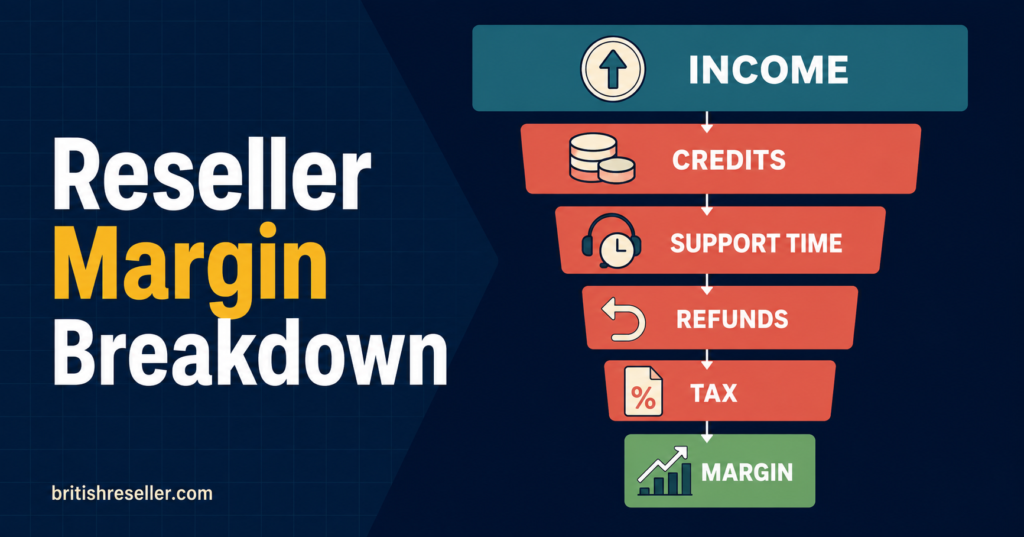
Buying and reselling credits is only one part of running the business. A realistic view of IPTV Reseller Profit Margin UK has to include the costs that don’t show up on a pricing page.
Trial lines cost you nothing in credits, but they cost you time. Every trial you generate for a prospect who never converts is time spent on someone who adds nothing to your revenue. If your conversion rate from trial to paying customer is low, that time cost becomes significant once you’re running dozens of trials a week.
Support and troubleshooting also carry a real cost, even if it’s not one you invoice for. A customer whose line stops working because of a router restart or an app update still expects a response, and the hours you spend answering messages come straight out of the time you could otherwise spend acquiring new customers. Resellers who build a habit of quick self-service guidance, rather than manually diagnosing every ticket, tend to protect their margin better simply because they’re not trading hours for pennies.
Refunds and chargebacks matter too. A customer who pays for six months and asks for money back after two weeks has already consumed credits you can’t get back from your provider. Clear refund terms, set out before the sale rather than negotiated after a complaint, reduce how often this situation arises.
Pro tip: Set a firm, written refund window before you take payment. Ambiguity here is one of the most common ways resellers quietly lose margin on paper-thin sales.
IPTV Reseller Profit Margin UK: What the Numbers Really Look Like
There’s no fixed, universal percentage that applies to every reseller, and any article claiming a specific average is presenting a guess dressed up as data. What matters more is understanding how the calculation actually works so you can apply it to your own pricing.
Take the basic structure: your cost per line is the credit price divided across however many credits that subscription length consumes. Your revenue per line is whatever you charge the customer. The difference between those two figures, before you subtract time, support and business costs, is your gross margin on that single sale. Your actual take home is that gross figure minus everything covered in the previous section.
This is why two resellers charging identical prices can end up with very different results. One might spend an hour a week on support because their customers are self-sufficient and their setup instructions are clear. The other might spend ten hours a week firefighting because trials were handed out without any screening and refund terms were never made explicit. Same credit cost, same sale price, very different outcome.
Volume changes the picture too. Buying credits in larger packages typically brings the per-credit cost down, which improves your gross margin without touching your sale price at all. That’s one of the few adjustments a reseller can make without any risk of upsetting existing customers, provided the capital is available to buy ahead of demand rather than reactively.
How Sub-Reseller Accounts Change the Calculation
Bringing on sub-resellers is often presented as a straightforward way to scale, and it can be, but it changes your margin structure in ways worth understanding before you set it up.
When you allocate a credit pool to a sub-reseller, you’re usually selling those credits to them at a markup above your own cost, and they then sell lines to their own customers at their own markup. Your margin on that layer is smaller per credit than your margin on a line you sell directly, because there’s now a second party taking a cut further down the chain. What you gain is volume without doing the customer-facing work yourself.
The trade-off is oversight. If a sub-reseller mishandles customer support or makes promises you can’t back, the reputational and support fallout often lands back on you, particularly if your business name is attached to the panel they’re operating under. A IPTV reseller panel with granular permissions lets you limit what a sub-reseller can see and change, which reduces that risk without removing the margin benefit entirely.
Pro tip: Review sub-reseller credit usage weekly rather than monthly. Problems with mismanaged trials or unauthorised discounting are far easier to correct early than after several weeks of unchecked activity.

Tax and Registration Costs You Can’t Ignore
Profit margin calculations that stop at the credit price miss a category of cost that applies to every UK reseller regardless of scale: tax obligations.
If your gross trading income (before any expenses) goes over £1,000 in a tax year, you’re required to register with HMRC for Self Assessment, even if your actual profit after costs is far lower. Once your taxable turnover reaches £90,000, VAT registration becomes mandatory, and from April 2026, sole traders with combined self-employment and property income above £50,000 fall under Making Tax Digital for Income Tax, which means quarterly digital record submissions rather than a single annual return.
None of this is a modest side detail. A reseller operating casually without registering, assuming a “hobby” framing protects them, can end up with backdated liabilities that wipe out months of what looked like profit. Building basic bookkeeping into your routine from the first sale, rather than retrofitting it once HMRC comes calling, is one of the more boring but genuinely protective habits a reseller can adopt.
Mistakes That Quietly Erode Margin
Building a More Sustainable Margin
None of the factors above mean reselling isn’t worthwhile. They mean the margin you actually keep depends on how disciplined the operational side of the business is, not just how aggressively you price your subscriptions.
Buying credits in larger, planned batches rather than reactive small top-ups tends to improve your baseline cost. Keeping support responses fast and self-explanatory reduces the hidden time cost per customer. Screening trial requests, even loosely, cuts down on wasted credits. And treating tax registration as a day-one task rather than an afterthought protects whatever margin you’ve actually earned from being clawed back later.
Resellers who track these factors properly, rather than relying on a single “credits in, cash out” mental model, tend to have a much clearer and more accurate picture of what their business is actually earning them.
Frequently Asked Questions
Is there a typical profit margin for IPTV resellers in the UK?
No fixed figure applies across the board, since it depends on your credit cost, subscription pricing, support workload and business overheads. The honest answer is that it varies enough between individual resellers that a single average number would be misleading.
Do sub-reseller accounts reduce my overall profit margin?
Per credit sold to a sub-reseller, your margin is typically smaller than a line you sell directly, because a second party is now taking their own markup further down the chain. The benefit is added volume without doing the customer-facing work yourself.
Does the length of a subscription affect how much margin I make per line?
Yes. Longer subscriptions usually consume more credits but also let you charge more upfront and reduce how often you chase renewals, which changes both your margin per sale and your ongoing admin time.
At what point do I need to register with HMRC as a reseller?
Once your gross trading income exceeds £1,000 in a tax year, registration for Self Assessment becomes required, regardless of what your actual profit after costs works out to be.
Do I need to register for VAT as a reseller?
Only once your taxable turnover reaches £90,000 over a rolling twelve-month period, though some resellers register voluntarily earlier to reclaim VAT on business purchases.
What’s the easiest way to improve margin without changing my prices?
Buying credits in larger batches usually lowers your per-credit cost, and tightening how trials and refunds are handled reduces wasted credits, both of which improve margin without touching what customers pay.
Where Your Margin Actually Ends Up
IPTV Reseller Profit Margin UK isn’t just the gap between your credit cost and your sale price. It’s what remains after trials, support time, refunds, sub-reseller structures and tax obligations have all taken their share. Resellers who treat those factors as part of the core business, rather than background noise, end up with a far more accurate and defensible number than anyone relying on a rough credits-in, cash-out estimate. Start by reviewing your own credit cost against your actual time spent per customer this month, and the real figure will be far clearer than any generic percentage could tell you.
Reseller Margin Checklist
- Calculate cost per line based on actual credits consumed, not just the headline package price
- Set a written refund window before taking payment
- Screen trial requests with at least one qualifying question
- Review sub-reseller credit allocation and usage weekly
- Track gross trading income against the £1,000 HMRC registration threshold
- Monitor taxable turnover against the £90,000 VAT threshold
- Buy credits in planned batches rather than reactive small top-ups
- Review available IPTV reseller panel features for tools that reduce manual support time