

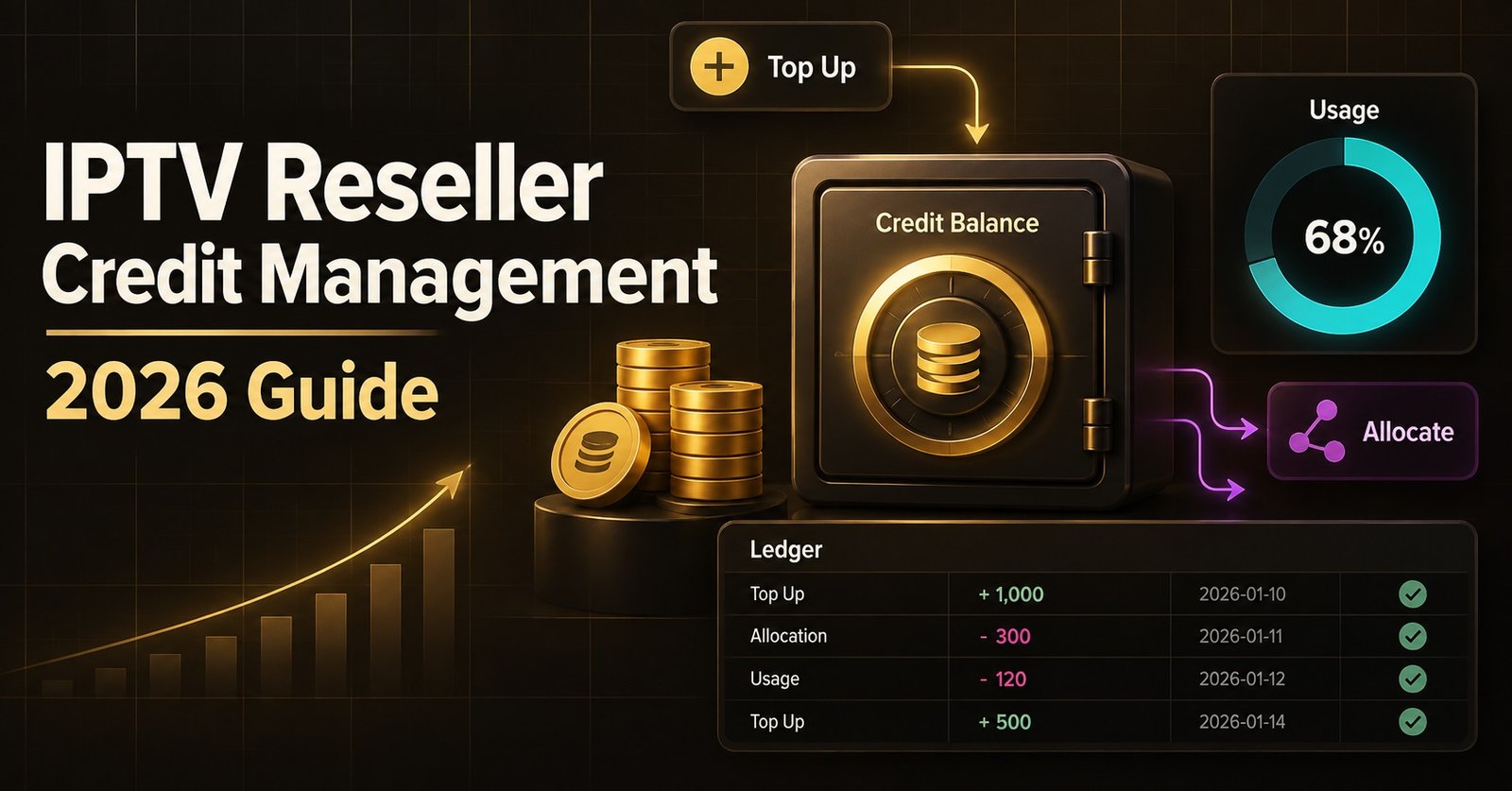
IPTV Reseller Credit Management is the ongoing discipline of allocating, forecasting and auditing the credits sitting in your panel, rather than treating credits as something you simply top up whenever the balance looks low. Buying credits is a one-off transaction. Managing them is a running process, and the two get confused far too often, usually right before a UK IPTV reseller runs out at the worst possible moment.
What IPTV Reseller Credit Management Actually Covers
Most resellers learn the basics fast enough. Buy credits, deduct them when a line is created, top up when the balance gets low. That part is straightforward and any panel will explain it in a paragraph. What tends to get skipped is everything that sits around that basic loop: knowing how many credits you’ll realistically need next month, deciding how much of your balance to hand over to sub-resellers, keeping a record you can actually check when a customer disputes an activation, and noticing early when your spending pattern has quietly shifted.
None of that is complicated on its own. It just doesn’t happen automatically, and a panel that tracks transactions for you is not the same thing as a reseller who is actively managing that data.
Why This Becomes a Problem Once You Scale
A reseller with a handful of customers barely notices credit management as a separate task. You check the balance occasionally, buy more when it feels low, and everything works out because the volume is small enough to hold in your head.
That stops working somewhere between twenty and a hundred active lines. Renewals start clustering around certain days of the month. Sub-resellers, if you’ve brought any on, start drawing down credit pools at different rates. A promotional push or a seasonal spike in demand can drain a balance in days rather than weeks. At that point, “check occasionally and top up when it feels low” turns into running out on a Friday evening when nobody can process a manual reload until Monday, and a paying customer is left without a working line through no fault of their own.
Pro tip: Set a personal reorder threshold well above zero, for example enough credits to cover roughly two weeks of your average renewal volume, and treat hitting that threshold as the trigger to buy, not the actual balance running out.
Forecasting Demand Instead of Reacting to It
Forecasting sounds like something only larger operations need, but it’s really just pattern recognition applied to your own renewal dates. Most IPTV Panel resellers already have the raw data sitting in their dashboard, they just haven’t looked at it that way.
A few things worth tracking properly:
- How many lines expire in each of the next four weeks, since renewals are predictable credit demand you already know is coming
- Which subscription lengths your customers actually choose most, since a base heavily weighted toward twelve-month lines behaves very differently to one built on monthly renewals
- Whether new customer sign-ups follow any seasonal pattern, such as increased interest around major sporting calendars or festive periods
- How much buffer you needed last time demand spiked unexpectedly, so you’re not guessing the same number twice
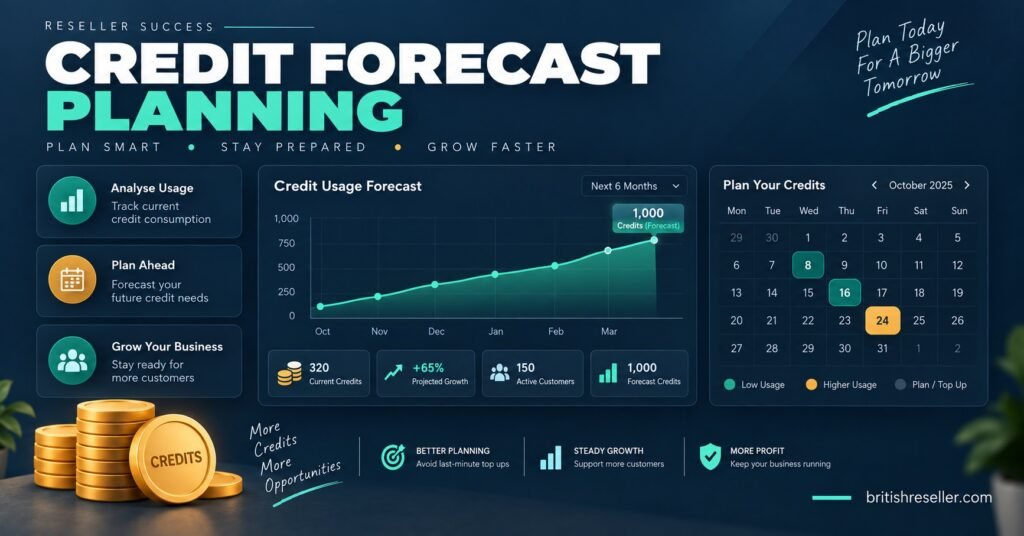
Once you can see roughly how many credits the next month will actually consume, buying stops being a reaction to a low balance and becomes a scheduled part of running the business.
IPTV Reseller Credit Management Across Sub-Reseller Accounts
Allocation gets genuinely harder the moment sub-resellers enter the picture. Each sub-reseller typically operates with their own credit pool, drawn from your main balance, and their spending pattern is largely outside your direct view unless you’re checking it deliberately.
Handing over a large pool and walking away invites two separate problems. Either the pool runs dry unexpectedly and their customers suffer for it, which reflects on your business even though you didn’t cause it directly, or the pool sits mostly unused, tying up credits that could be working elsewhere in your operation. Neither outcome is really about trust. It’s about visibility, and a dashboard built for sub-reseller management should let you see individual pool activity rather than just a single combined total.
A sensible approach is to size each sub-reseller’s pool against their actual historical usage, reviewed monthly rather than set once and forgotten, with smaller top-ups happening more frequently instead of one large allocation that has to last an unpredictable stretch of time.

Common Credit Management Mistakes
| Mistake | Why It Hurts | Better Approach |
|---|---|---|
| Topping up only when the balance hits zero | Leaves no buffer for weekend or overnight demand | Reorder at a set threshold above zero |
| Treating all sub-reseller pools the same size | Ignores different usage rates between accounts | Size pools against actual historical draw-down |
| Never reviewing the credit log | Makes disputes and audits slower and less reliable | Check the log monthly, not only when something goes wrong |
| Buying in large one-off bursts with no schedule | Creates unpredictable cash outlay and idle stock | Buy smaller amounts on a consistent, planned cycle |
Keeping a Control Trail You Can Actually Use
Every credit transaction leaving your account should be explainable later without guesswork. If a customer says their line was never activated, or a sub-reseller disputes how many credits they were given, the credit log is what settles it, provided you’ve actually been checking it rather than letting it sit unread.
Treat the log as a working record, not an archive. A short monthly review, checking that credit spend roughly matches the number of lines created and renewed, catches errors early: a line created twice by mistake, credits deducted for a trial that should have been free, or a sub-reseller pool drawn down faster than their reported customer base would suggest. Catching that in month one is a five-minute fix. Catching it after six months is a much longer conversation.
Pro tip: Reconcile your credit log against your active line count at the same time each month, so any mismatch is spotted while it’s still small enough to trace back to a single cause.
Warning Signs Your Credit Management Needs Attention
A few patterns are worth taking seriously rather than dismissing as one-off blips:
- You’ve had to make an emergency top-up more than once in the last few months
- You can’t say with confidence how many credits a given sub-reseller has used this quarter
- Your balance and your active line count don’t roughly line up when you do the maths
- You’re buying credits in a rush rather than on any kind of schedule
- Renewal-heavy weeks consistently catch you short
None of these mean the business is failing. They mean the management side hasn’t kept pace with the growth, which is a fixable gap rather than a structural problem.
Credit Management Checklist
- Set a reorder threshold above zero rather than waiting for an empty balance
- Review upcoming renewals for the next four weeks on a regular basis
- Size sub-reseller credit pools against actual usage, not a flat default
- Check the credit log monthly against your active line count
- Note any seasonal spikes so next year’s forecast starts from real data
- Buy on a planned cycle instead of reacting to a low-balance alert
Frequently Asked Questions
How many credits should I keep in reserve?
There’s no fixed number that suits every reseller, since it depends on your renewal volume and how quickly you can top up when needed. A reasonable starting point is enough to cover roughly two weeks of average usage, adjusted upward if top-ups take time to process or if you run active sub-reseller accounts.
Do unused credits expire?
This varies by provider, so check your own panel’s terms directly. Many panels, including this one, don’t expire unused credits, but it’s worth confirming rather than assuming, especially if you’re planning to stock up well ahead of expected demand.
Should I give sub-resellers large credit pools upfront?
Generally no. A smaller pool reviewed and topped up regularly gives you far more visibility than one large allocation handed over and left alone, and it limits the damage if a pool is drawn down faster than expected.
What’s the fastest way to spot a credit management problem?
Compare your credit log against your active line count. If the numbers don’t roughly match, something in the process, whether it’s duplicate lines, incorrect trial handling, or an untracked sub-reseller draw-down, needs a closer look.
Is credit management different from just buying credits?
Yes. Buying credits is a single transaction. Management is the ongoing process of forecasting how many you’ll need, allocating them sensibly across your operation, and keeping records that let you explain every deduction later.
Conclusion
IPTV Reseller Credit Management is less about the moment you click buy and more about everything that happens between purchases: forecasting what’s coming, allocating sensibly across any sub-resellers, and keeping a log you actually check rather than one that just sits there. None of it demands specialist tools beyond what a properly built IPTV reseller panel dashboard already tracks. It mainly demands a habit of looking at that data on a schedule instead of only when the balance hits zero. Start with a reorder threshold and a monthly log review, and most of the running-dry moments that catch resellers off guard simply stop happening. If you’re still working out the right credit package for your current volume, sizing it against your actual renewal pattern rather than a round number is the more reliable starting point.