

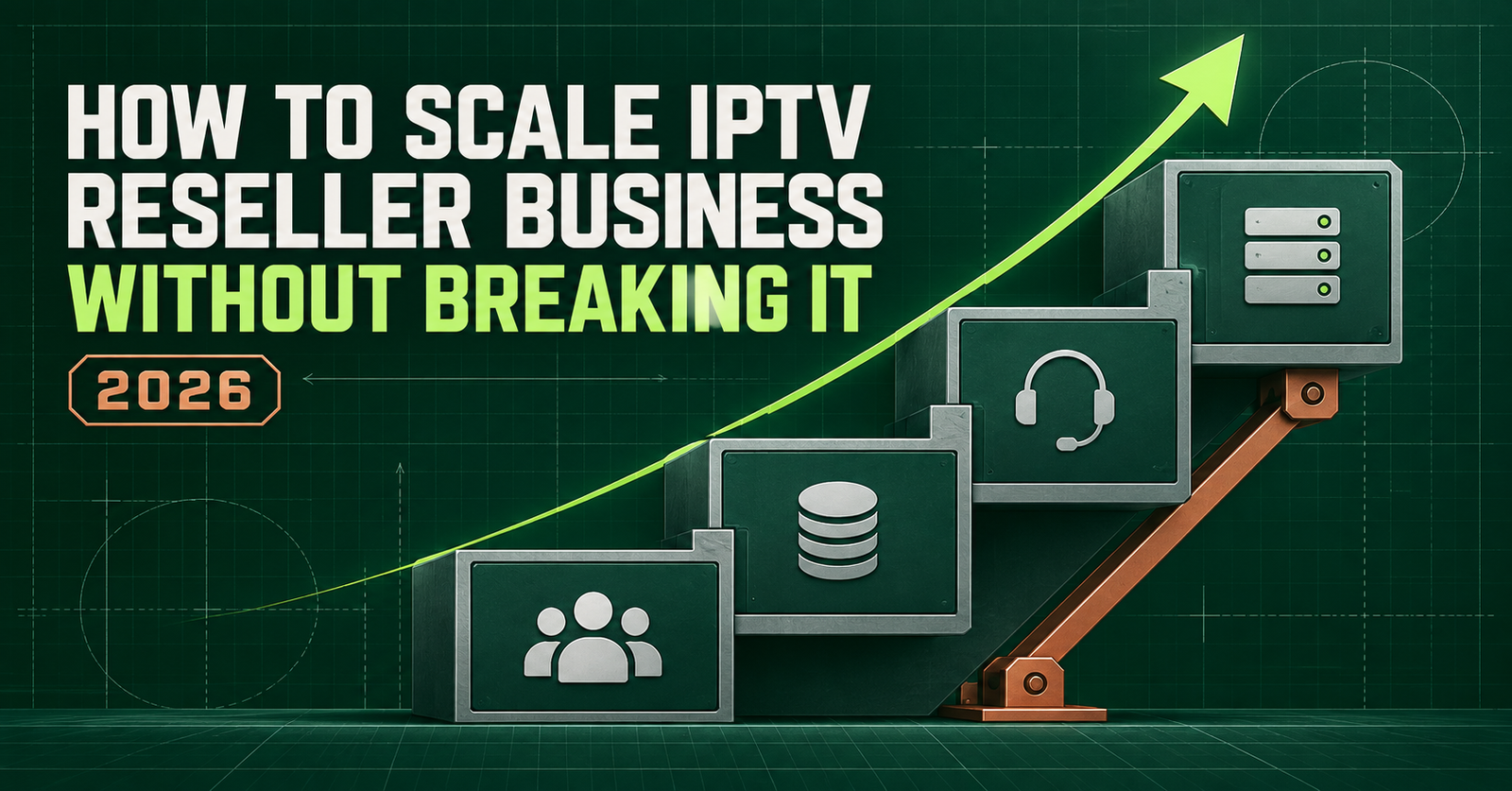
You scale IPTV reseller business operations by strengthening the systems that break under volume before you add more customers, not after. Credit management, line creation speed, sub-reseller structure and support response time all have to hold up first. Add customers to a setup that already struggles, and growth just multiplies the strain rather than the income.
How to Scale IPTV Reseller Business Without Breaking What Already Works
Most IPTV panel resellers hit the same wall. Everything runs fine at twenty or thirty active lines. A single person can manage renewals, answer questions on WhatsApp, and top up credits whenever the balance runs low. Then the customer base doubles, and the same manual process that felt manageable starts eating hours every day. Renewals get missed. Support messages sit unanswered overnight. Credit purchases become reactive instead of planned.
Scaling isn’t really about acquiring more customers. It’s about building the operational capacity to serve more customers without the quality of service dropping. That distinction matters because a lot of resellers chase growth in the wrong order, marketing harder before their dashboard, support workflow, and pricing structure can actually absorb the extra volume.
Where Growth Actually Breaks Down
The breakdown point is rarely the IPTV technology itself. It’s almost always a process issue that only becomes visible once volume increases.
| Growth Stage | What Typically Breaks | Practical Fix |
|---|---|---|
| 20-50 lines | Manual renewal tracking | Set expiry alerts inside the IPTV reseller panel rather than a spreadsheet |
| 50-150 lines | Slow response to support messages | Fixed response windows and templated answers for common issues |
| 150+ lines | One person managing everything | Sub-reseller accounts or a second operator with defined permissions |
A reseller stuck at any of these stages usually isn’t short of demand. They’re short of a system that lets them handle demand without personally touching every single line.

Credit Management Has to Come Before Customer Volume
Buying credits reactively, only when the balance nears zero, works fine at small scale. It becomes a liability once you’re managing dozens of active customers with staggered renewal dates. A single delayed top-up during a busy week can mean several customers losing access at once, and that’s the kind of experience that pushes people to look elsewhere.
The fix is straightforward but often skipped. Review your average monthly credit consumption, then keep a buffer that covers at least two to three weeks of expected usage. Resellers running a credit-based reseller model generally find this buffer prevents the panic top-ups that happen right before a renewal deadline.
Pro tip: Track credit usage against renewal dates for one full month before setting your buffer size. Guessing the number tends to either waste money on excess credits or leave you short during peak renewal weeks.
Building a Sub-Reseller Network Instead of Doing Everything Yourself
Sub-reseller accounts are the clearest lever for scaling past what one person can manage alone. Instead of you personally creating every line and answering every message, a sub-reseller operates under your panel with their own credit allocation and their own customer base, while you retain oversight of the account structure underneath them.
This only works cleanly with clear terms set from the start. Decide in advance how credit pools are assigned, whether the sub-reseller handles their own customer support or escalates to you, and what happens if a sub-reseller account goes inactive. Vague arrangements tend to create disputes later, usually around who owns a customer relationship or who’s responsible when something goes wrong.

Pro tip: Start with one sub-reseller before building out a wider network. It’s far easier to spot gaps in your permissions and support structure with one account than to discover the same gaps across ten accounts simultaneously.
Support Capacity Is the Part Resellers Underestimate
Response speed is one of the biggest differentiators between resellers who retain customers and resellers who don’t, and it’s also one of the first things to slip during a growth phase. A customer whose line stops working expects a reply within a reasonable window, not the next day.
As volume grows, informal support through personal messaging apps stops scaling. Consider organising common issues, buffering complaints, login problems, device setup, into a short internal reference so you or a sub-reseller can respond consistently rather than re-explaining the same fix from memory each time. Guides like the IPTV reseller panel guide are useful for pointing customers toward self-service answers on common setup questions, which reduces the volume of repetitive tickets landing on you directly.
Pricing Structure Should Reflect Your Actual Costs at Scale
Pricing that works at ten customers doesn’t automatically work at two hundred. Heavy discounting to win early customers is common, but it becomes a genuine problem once support time, credit costs, and sub-reseller commissions are factored into the real margin per line.
Before scaling further, calculate your actual cost per active line, including credits consumed, average support time, and any commission paid to sub-resellers. If that number is close to what you’re charging, growth will increase your workload without meaningfully increasing your income. Adjusting pricing before scaling, rather than after, avoids having to raise prices on an already large customer base all at once.
Pro tip: Review pricing every quarter rather than setting it once and leaving it. Credit costs and support demands both shift over time, and a price that made sense six months ago may no longer cover your actual costs.
Retention Matters More Than Constant New Sign-Ups
Chasing new customers while losing existing ones at a similar rate leaves you working harder without the customer base actually growing. Retention usually comes down to a handful of practical factors: reliable renewals, fast support responses, and transparency about what a customer is actually paying for.
Customers who churn rarely leave because of price alone. They leave because a renewal was late, a support message went unanswered, or a line stopped working with no clear explanation. Fixing the operational issues covered above tends to improve retention on its own, often more effectively than any promotional offer.
IPTV Reseller Growth Checklist
- Confirm your credit buffer covers at least two to three weeks of average usage
- Set expiry alerts inside your dashboard rather than tracking renewals manually
- Document common support issues so responses stay consistent across operators
- Define sub-reseller permissions and credit allocation in writing before onboarding one
- Recalculate your real cost per line before adjusting or expanding pricing tiers
- Review response times monthly and address any that are slipping
Frequently Asked Questions
How many customers can one reseller realistically manage alone?
It depends heavily on renewal frequency and support demand rather than a fixed number. Many resellers manage fifty to eighty active lines comfortably alone if renewals are staggered and support volume stays low. Once support messages become a daily, time-consuming task, that’s usually the signal to bring in a sub-reseller or a second operator.
Is a sub-reseller network necessary to grow, or can automation alone handle it?
Automation through dashboard tools handles repetitive tasks like line creation and expiry tracking, but it doesn’t replace the human side of support and customer communication. Most resellers find a combination works best: automation for the operational tasks, and a sub-reseller network for handling a larger customer base without one person answering every message.
What’s the most common mistake resellers make when trying to scale quickly?
Marketing for new customers before the underlying systems can support them. This usually results in slower support responses, missed renewals, and a drop in service quality that undoes the benefit of the extra sign-ups.
Should pricing stay the same as a reseller business grows?
Not necessarily. Costs per line, including credits, support time, and any sub-reseller commissions, tend to shift as volume increases. Reviewing pricing periodically against actual costs helps avoid a situation where growth increases workload without a matching increase in margin.
How do I know if my dashboard setup is holding back growth?
Signs include manually tracking renewals outside the panel, spending significant time on tasks the dashboard should automate, or lacking visibility into credit usage patterns. If you’re relying on memory or spreadsheets for tasks the panel is designed to handle, that’s usually a bottleneck worth addressing before adding more customers.
To scale an IPTV reseller panel business operations sustainably, fix the systems most likely to break under volume before chasing more sign-ups: keep a credit buffer that matches your renewal pattern, bring in sub-resellers with clearly defined permissions, and treat support response time as seriously as pricing. Growth that outpaces your operational capacity tends to cost more in lost customers than it gains in new ones, so build the foundation first and let the customer base grow into it rather than the other way round.