

Good IPTV Reseller Chargeback Prevention UK comes down to three things: a customer who knows exactly what they bought, a refund route that is easier than calling their bank, and a record of activation and support that you can produce within days. Most disputes in a IPTV subscription reseller business are not organised fraud. They come from customers who did not recognise the charge on their statement, could not get the service working on the first evening, or were renewed at a price they had forgotten agreeing to.
Before you spend money on dispute software, look at your own checkout and support flow. If a customer’s quickest way to get money back is their banking app rather than a message to you, you will keep losing disputes no matter how good your evidence is. Fix that first, then build the paperwork.
Why a Small Subscription Can Put the Whole Payment Account at Risk
A disputed monthly line looks like a minor loss. In practice it costs more than the sale. The credit has already been spent in your panel to activate the line, most processors charge a dispute fee whether you win or lose, and your time goes into gathering evidence for a small amount.
The bigger issue is the ratio. Card networks and processors track how many of your transactions end in fraud reports or disputes. Visa merged its fraud and dispute monitoring into a single programme, and on 1 April 2026 it tightened the “Excessive Merchant” threshold from 2.2% to 1.5% for merchants in several regions. A single transaction can count twice if the bank first reports it as fraud and the cardholder then escalates it into a formal chargeback.
Most small resellers will never reach the volume Visa formally monitors, because the 1,500 combined fraud and dispute event monthly minimum still applies. That does not make you safe. Your acquirer’s internal thresholds may be stricter than Visa’s, and a processor that closes your account does not need to wait for a network fine. For a IPTV reseller who takes payments through one provider, losing that account can stop renewals overnight.
The timing works against you too. With digital goods, the customer typically has up to 120 days from the transaction date to file a chargeback. Your response window is far shorter, and processors such as Stripe document a due date of 7 to 21 days after the dispute is filed. If a customer pays through a wallet service instead, they might have 180 days to file.
Five Moments Where Disputes Usually Begin
Chargebacks feel random when they arrive, but they tend to trace back to a handful of predictable moments in the customer relationship. Treat each one as a separate leak.
The checkout page
If the name on the customer’s statement does not match the name they saw when paying, many will assume the charge is fraudulent. Check your billing descriptor with your processor and make it match your trading name, not a parent company or a generic payments label. Put the price, the duration, and whether it renews automatically right beside the pay button, not three clicks away in your terms.
The first evening
A customer who pays at 7pm and cannot log in by 9pm is a high dispute risk. They have no working service, no reply from you yet, and a banking app that promises help in two taps. Send login details with simple setup steps straight away, and make sure your support hours are visible before payment. A short, device-specific guide does more here than a long FAQ page. If most of your customers use Android TV boxes, pointing them to a clear guide to choosing an IPTV app for Android TV removes a common source of first-night frustration.
Pro tip: Offer a short trial line before the first paid order. Anyone who has already seen the service working on their own device is far less likely to claim it was never delivered.
A mid-month service problem
When streams drop or a line stops working and nobody replies, the customer stops thinking of you as a supplier and starts thinking of you as someone who took their money. Acknowledge the issue quickly, even before you have a fix, and record that you did.
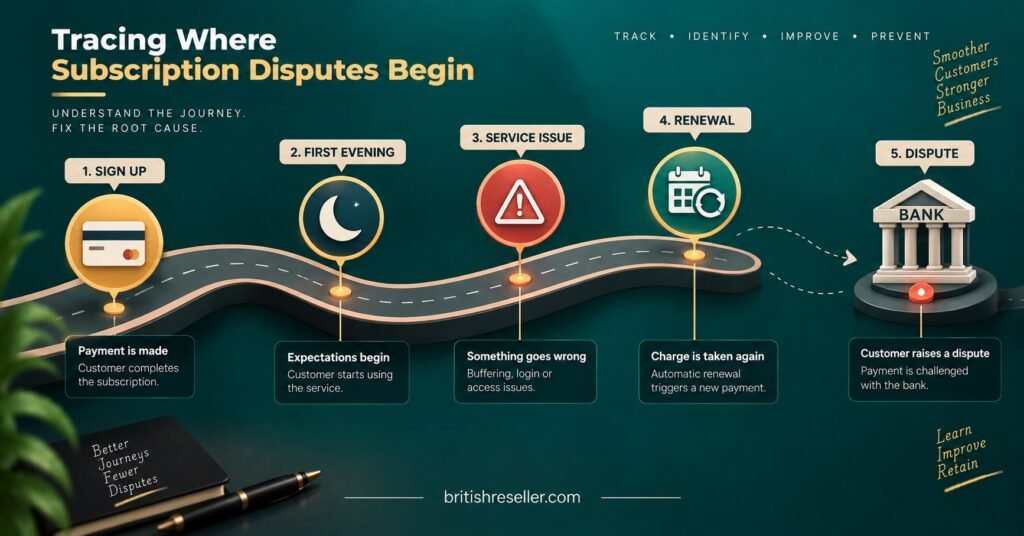
The renewal date
Automatic renewals that arrive without warning are one of the easiest dispute triggers to prevent. A reminder a few days before the charge, with a simple way to cancel, costs you a small number of renewals and saves you a larger number of disputes. It will also matter more from next year, as covered below.
The customer who forgets you exist
Some disputes come from people who genuinely do not remember the purchase, often because a family member bought it or it was paid for on a shared card. A clear descriptor and a confirmation email with your name and support contact go a long way here.
IPTV Reseller Chargeback Prevention UK Starts With Your Terms, Not Your Panel
UK consumer law shapes what a reasonable refund position looks like, and a clear one gives you something to point to when a bank asks why you refused a refund. This is general information rather than legal advice, and it is worth having a solicitor check your terms if you sell at any volume.
Online sales to UK consumers generally come with a 14-day cancellation right under the Consumer Contracts Regulations 2013. How that applies to a streaming subscription depends on whether it is treated as a service or as digital content, and the rules differ. For services, if the customer asks for the service to start straight away, they keep the right to cancel but must pay for the value provided up to that point. For digital content supplied without a physical medium, the trader must not begin supply before the end of the cancellation period unless the consumer has given express consent and acknowledged that the right to cancel will be lost.
That consent needs to be real. Guidance on the underlying rules says the consumer must take a “positive action”, such as an unticked tick-box, and that a pre-ticked box or a reference to general terms is likely not to be sufficient. The penalty for skipping cancellation information is significant too: the cancellation period extends by an additional 12 months if the trader fails to provide valid notice of the right to cancel.
The rules on auto-renewing subscriptions are also changing. The government has confirmed that the subscription contracts regime under the Digital Markets, Competition and Consumers Act 2024 is expected to commence in Spring 2027 and will impose consumer journey requirements across the subscription lifecycle, including clear information before sign-up and regular reminders, particularly before trials or 12-month-plus contracts auto-renew. Building renewal reminders and easy cancellation now prepares you for that and cuts disputes at the same time.
Pro tip: Save the consent record itself, not just the fact that a box exists on your checkout. A timestamped record of the customer ticking it is what turns your terms into evidence.
Reading the Reason Before You Reply
Every dispute arrives with a reason, and the reason tells you what the bank expects to see. Answering a “not recognised” claim with the same evidence you would use for a “service not provided” claim wastes your one chance to respond.
| Dispute reason given | What usually sits behind it | What prevents it next time |
|---|---|---|
| Fraud or unauthorised payment | Unfamiliar descriptor, or a family member used the card | Matching descriptor, confirmation email naming your business |
| Service not received | Customer could not log in or set up the device | Instant login delivery, device guides, visible support hours |
| Not as described | Expectations set by marketing did not match reality | Plain, accurate descriptions without absolute promises |
| Cancelled subscription | Renewal they did not expect or could not stop | Renewal reminders and a simple cancellation route |
| Duplicate or incorrect amount | Double payment or price change | Payment reconciliation and advance notice of price changes |
Notice that the last column is almost all operational. Very little of it involves fighting disputes after they happen.
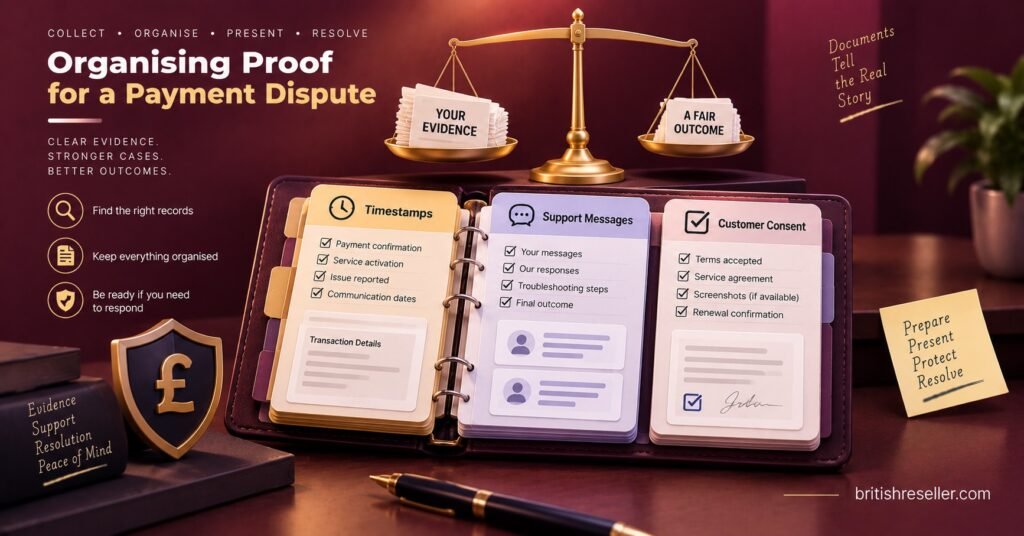
Building an Evidence File That Holds Up
When you do contest a dispute, the bank wants proof that the customer bought what they received and used it. A IPTV reseller panel already produces much of this, if you keep it organised.
The credit log in a well-built panel records when a line was created, for how long, and against which account. The British Reseller panel’s credit log is one example, which records every transaction with timestamps, line details, and credit amounts, so if a customer disputes an activation date the information is there without asking support to look it up. Pair that with your own records: the order confirmation, the message containing login details, any support conversations, and the checkout consent record.
For fraud claims, there is a stronger tool worth asking your processor about. Visa’s Compelling Evidence 3.0 lets you show earlier undisputed payments from the same customer with matching device or network details, which helps prove a returning customer rather than a stolen card. When a CE 3.0 representment succeeds on a fraud dispute, the merchant keeps the revenue and avoids the enforcement fee on that transaction. Whether you can use it depends entirely on what your processor supports and what data your checkout captures.
One caution: keeping logs about customers brings UK GDPR obligations. Hold what you genuinely need for billing and dispute handling, say so in your privacy notice, and set a sensible retention period rather than keeping everything forever.
When Refunding Beats Fighting
Winning a dispute still leaves it counted against you in most monitoring programmes. That changes the maths for small amounts.
If a customer contacts you asking for money back, a quick refund usually costs less than a dispute fee plus lost time, and it never enters your dispute count. Some processors also offer pre-dispute alert and resolution services, which let you refund before a chargeback is formally raised. Visa’s own monitoring excludes disputes resolved through pre-dispute solutions like RDR and CDRN, so ask your processor whether any of these are available on your account.
Fight when the evidence is strong and the pattern matters: a customer who used the service for weeks and then claimed it never worked, or someone who disputes every renewal. Refund when the customer has a fair point or the amount is too small to justify the effort. Being consistent matters more than winning every case.
Pro tip: Track your dispute count monthly next to your sales count, even as a simple spreadsheet. A rising ratio is much easier to fix at the first sign than after a warning from your processor.
Honesty With Your Processor and Your Sub-Resellers
Many payment providers treat streaming resale as a higher-risk category, and some restrict it. Describe your business accurately when you apply and when anything changes. Accounts opened under a vague description tend to be closed abruptly when the provider looks closer, often with funds held for months, and that is a far bigger loss than any single chargeback.
It is also worth being clear with customers and with yourself that IPTV is a delivery technology, and whether a given service is lawful depends on the rights and permissions behind the content. No payment method or professional-looking checkout proves that on its own.
If you run sub-resellers, remember that disputes land on whoever took the card payment. If your sub-resellers sell to end customers but payments run through your account, their weak onboarding becomes your dispute ratio. Agree who handles refunds and support before you give them access, and expect the same descriptor, confirmation, and consent standards from them.
Frequently Asked Questions
How long after a payment can a UK customer raise a chargeback?
Under card network rules, usually up to 120 days from the transaction, though some cases start the clock later. Where the start date is deferred, the dispute must still fall within an overall cap, typically 540 days from the original transaction.
Does winning a dispute remove it from my dispute ratio?
Generally not. Most monitoring counts disputes when they are raised rather than by outcome, which is why preventing and pre-resolving disputes is worth more than winning them.
Is a “no refunds” policy enough to stop chargebacks?
No. Banks look at whether the customer was clearly told the terms and whether they received what they paid for. A blanket no-refunds line that ignores UK cancellation rights can weaken your position.
Should I accept bank transfers instead of cards to avoid chargebacks?
Bank transfers do not carry card chargeback rights, but they bring their own problems, including slower onboarding and scam-related refund claims. Choosing a payment method purely to avoid consumer protection also tends to damage trust. Clear terms and good support work better.
What should I do when the first dispute arrives?
Read the reason, check the deadline your processor shows, gather the evidence that matches that reason, and respond before the deadline. Then look back at which of the five moments above caused it.
Where to Put Your Effort First
IPTV Reseller Panel Chargeback Prevention UK is mostly about removing the reasons a customer would go to their bank in the first place: a recognisable descriptor, clear terms with proper consent, fast login delivery, visible support, and renewal reminders. Evidence and dispute tools matter, but they protect the minority of cases that prevention does not catch. The rules around subscriptions are also tightening, so what counts as good practice today will become an expectation soon. Start with your checkout page and your first-evening support process this week, then build the evidence file around them.
Dispute Evidence File Checklist
- Order confirmation showing your trading name, price, duration, and renewal terms
- Timestamped record of the customer’s cancellation-right consent at checkout
- Panel credit log entry showing when the line was created and for how long
- Copy of the message that delivered login details and setup instructions
- Every support conversation with the customer, including your response times
- Record of any renewal reminder sent before the charge
- Refund offers or goodwill gestures made before the dispute