

A workable IPTV Reseller Refund Policy does three jobs clearly: it says when money comes back, how much comes back, and how quickly, for both unused panel credits and the subscriber lines you sell. If any of those three is vague, every refund request turns into a negotiation over a messaging app, and negotiations are where resellers lose both money and reputation.
Most weak policies go wrong by being one policy. The credits you buy from your provider are a business purchase governed mainly by that provider’s terms, while the monthly line you sell to a household is a consumer contract with statutory rights underneath it, whatever your page says. Write those two parts separately, make sure the consumer wording does not try to remove rights the law already gives, and your published policy page will make far more sense to the people reading it.
Two Refund Relationships Sit Behind Every IPTV Reseller Panel
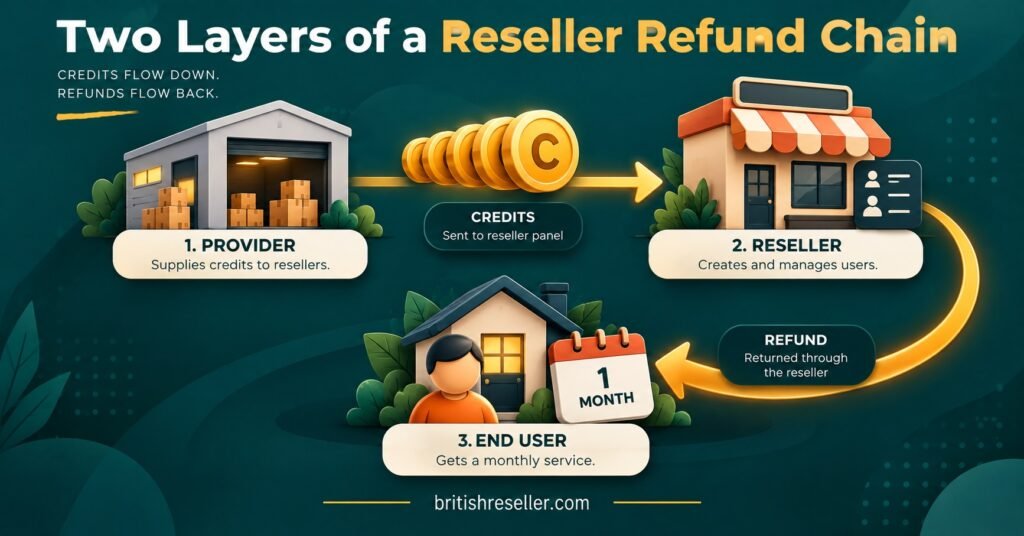
Picture the money flow. You pay your provider for credits, the credits sit in your panel, and one is deducted each time you create or extend a customer line. Your subscriber then pays you. A refund can be requested at either end of that chain, and the rules at each end are different.
Upstream: the credits you have bought
This is the relationship between you and the panel provider. Because you are buying for a business, UK consumer cooling-off rights generally do not apply to you, so the provider’s own terms carry most of the weight. The questions that matter are simple. Are unused credits refundable, and within what period? Is a credit that has already been turned into a line ever returned? What happens to a panel fee, if one was charged? Many providers treat an activated credit as consumed, so you should assume that until you see otherwise in writing.
Downstream: the lines you have sold
This is the relationship you control and the one your public policy page is really about. Your subscriber is usually a consumer, which means your terms sit on top of legal rights rather than replacing them.
The problem appears when the two layers do not match. If your provider will not return a spent credit but your page promises subscribers a full refund within 30 days, every refund in that window comes out of your margin. That can be a perfectly sensible commercial choice, provided you have made it deliberately.
Pro tip: Before publishing a subscriber refund window, write down what your provider actually returns to you in the same situation. If there is a gap, either shorten your promise or build the cost of that gap into your retail price.
What UK Consumer Law Already Decides for You
For online sales to UK consumers, the Consumer Contracts Regulations 2013 give a 14-day cancellation period. There are two important qualifications for a streaming line. Where a service starts during the cancellation period at the customer’s request, they can still cancel but may have to pay for what they have used. Where something counts as digital content supplied online, the right to cancel can be lost once supply begins, but only if the customer expressly asked for immediate access and acknowledged they would lose that right. A buried sentence in your terms does not achieve this. The request and acknowledgement need to be part of the purchase itself, before the line is activated.
Separately, the Consumer Rights Act 2015 expects services to be carried out with reasonable care and skill, and digital content to be of satisfactory quality and as described. If what you sold genuinely does not work, the customer has remedies whatever your policy says. When a refund is due following cancellation, it should normally be paid within 14 days.
Put together, this means a line such as “no refunds under any circumstances” does not protect you. It is unenforceable against those statutory rights and can itself be treated as misleading. A better policy explains how you handle the rights the customer already has.
Other English-speaking markets have their own rules, and several, including Australia and Ireland, also have consumer guarantees that a seller cannot contract out of. If you sell outside the UK, check the position where your subscribers live, and take proper legal advice for anything beyond general drafting. It is also worth being clear with yourself about one thing: a refund policy governs payments, not content. IPTV is a delivery technology, and whether a service is lawful depends on the rights and permissions behind what is delivered, not on how generous the refund terms are.
What an IPTV Reseller Refund Policy Should Actually Contain
Once the legal floor is understood, the policy itself is mostly about clarity. These are the sections that stop disputes before they start.
Who and what the policy covers
State plainly whether the page applies to subscribers, to sub-resellers buying credits from you, or to both. If both, split them under separate headings. A subscriber reading about credit allocations will assume the whole page is not written for them.
Trials, and where paid supply begins
If you offer a free trial line, say so and say what it is for: checking the service works on the customer’s own device and connection before paying. Then say clearly that paid supply starts at activation of the paid line. A trial is the single most effective refund-reduction tool a IPTV panel reseller has, because most “it doesn’t work” requests are really compatibility questions that a trial answers for free.
The window and what starts the clock
Give a fixed number of days and a fixed starting point, such as activation of the line rather than the payment date. Vague wording such as “shortly after purchase” invites argument.
Faults versus setup issues
This is where operator experience helps. A service that will not load at all on any supported device is a different matter from a stream that stutters on a congested home Wi-Fi network or an app the customer chose that handles playlists poorly. Your policy can reasonably ask customers to complete basic troubleshooting with your support first, and it can list the app and device setups you actually support. It should not use that process to stall a customer indefinitely where the fault is genuinely on your side.
How much comes back
Spell out the method: full refund before activation, pro-rata after use, or a partial amount reflecting days used. Pro-rata by day is the easiest to explain and the hardest to dispute.
How to ask and how long it takes
Name the channel, the details you need (order reference, line username, date of purchase), your response time for acknowledging a request, and that refunds go back via the original payment method.
Credits and sub-resellers
If you sell credits downstream, say whether unused credits are refundable, whether credits already allocated to a sub-reseller can be recalled, and who refunds the end customer of a sub-reseller. Usually that should be the sub-reseller, since they own the customer relationship, but it must be written down.
Where Refund Requests Actually Come From
Knowing why people ask for their money back tells you what your policy and your support process need to cover.
| Refund request | Usual cause | Better handling |
|---|---|---|
| “It won’t work on my TV” | Unsupported device or unsuitable player app | Offer a trial before purchase and publish supported setups |
| “It keeps freezing” | Home network congestion or Wi-Fi distance | Troubleshooting steps first, refund if a service-side fault is confirmed |
| “I didn’t mean to renew” | Unclear renewal terms | State renewal and reminder terms at checkout |
| “I bought the wrong length” | Twelve months chosen instead of one | Allow a quick switch within a short window before heavy use |
| “The service went down” | Genuine provider outage | Compensate with extra days or a pro-rata refund, and say which in the policy |
Device questions are the biggest share of avoidable requests in most IPTV reseller operations, which is why guidance such as this breakdown of the best IPTV app for Android TV is worth linking from your support replies before a customer reaches the refund stage.
Pro tip: Tag every refund request in your records with one of a handful of causes. After a few months, the pattern tells you whether to fix your checkout wording, your trial process, or your provider.
Wording That Creates Disputes Instead of Preventing Them
A few phrases turn up repeatedly on reseller policy pages, and each one causes more trouble than it prevents.
“All sales are final” contradicts the statutory position for UK consumers and gives the customer grounds to complain rather than a reason to accept your decision.
“Refunds are at our discretion” with no criteria reads as “we might say no for any reason”. If discretion exists, explain what you weigh when using it.
Marketing promises such as uninterrupted or buffer-free viewing then become the standard your service is measured against. If the sales page promises perfection, your refund page will be asked to pay for every imperfection.
Finally, a clear policy matters when a payment dispute or chargeback is raised, because the payment provider will look at what the customer agreed to. It is evidence of what you promised. It is not, on its own, proof that the service or the business is legitimate, and it should never be presented that way.
Subscription Rules Arriving in January 2027
The UK’s new subscription contracts regime under the Digital Markets, Competition and Consumers Act 2024 is now expected to go live in January 2027, earlier than the spring date previously expected. It applies to auto-renewing consumer subscriptions, so the first question is whether your lines renew automatically at all.
If they do, the regime adds a second 14-day cooling-off period after a renewal onto a 12-month term or after a free or discounted period rolls into paid billing, with a proportionate refund if the customer cancels in that window. For unlimited-access services, the government’s expectation is a pro-rated daily amount. Customers who signed up online must be able to cancel online without hunting for the option, and reminder, cooling-off and end-of-contract notices must be sent in writing on a durable medium. Email, text and messaging-app messages are expected to qualify, while in-app notifications that disappear are not.
Fixed-term prepaid lines that simply expire and need a fresh purchase may sit outside the regime, but the detailed guidance has not yet been published, so treat that as a question to confirm rather than an assumption.
Pro tip: If none of your plans auto-renew, say so in one plain sentence on the policy page. It answers a common customer worry and shows you have thought about the new rules.
Keeping the Policy Page and the Panel in Step
A policy is only as good as the process behind it. When a refund is issued, disable or delete the matching line in the panel the same day, so a refunded customer is not still watching a month later. Keep a simple log of the request, the reason, the amount and the date paid. Link the policy from your checkout and your order confirmation, not just the footer, and date each version so you can show which terms a customer accepted.
If you buy credits for resale, keep a copy of your provider’s own terms alongside yours. When those terms change, your subscriber policy may need to change with them, and the current IPTV reseller credit packages are the sensible place to start that comparison.
Frequently Asked Questions
Can a reseller refuse a refund once a line has been activated?
Sometimes, but not automatically. If the customer expressly asked for immediate access and acknowledged losing the cancellation right, the 14-day change-of-mind right may no longer apply. Rights relating to a service that does not work as described still remain.
Are unused IPTV credits refundable?
That depends entirely on the provider’s terms, because credit purchases are business transactions. Ask before buying, and get the answer in writing rather than relying on a chat message.
Should a refund policy offer extra days instead of money?
Extra days are a reasonable goodwill option for short outages, and many customers prefer them. They should be an offer, though, not a replacement for a refund the customer is legally entitled to.
Who handles refunds for a sub-reseller’s customers?
Normally the sub-reseller, since they took the payment and own the relationship. Your policy for sub-resellers should say this clearly, and should cover whether credits they allocated to a refunded customer come back to their balance.
Getting the Policy Right Before the Next Request Arrives
A strong IPTV Reseller Panel Refund Policy separates what you owe subscribers from what your provider owes you, respects the consumer rights that already exist, and replaces vague discretion with a clear window, a clear method and a clear timescale. It will not remove every dispute, and it cannot make up for an unreliable service or content you do not have the rights to deliver. What it can do is turn most refund conversations into a short, predictable process. Review your current page against the points above, check your provider’s credit terms, and if any of your plans auto-renew, start preparing for the January 2027 changes now rather than in December.
Reseller Refund Policy Drafting Checklist
- Separate subscriber refunds and credit or sub-reseller refunds under their own headings
- Confirm in writing what your provider returns for unused and activated credits
- Make sure your subscriber window does not promise more than you can afford to cover
- Capture the customer’s express request and acknowledgement before immediate activation
- State the refund window, its starting point, and the pro-rata method in plain numbers
- List supported devices and apps, and point customers to a trial before purchase
- Remove “all sales are final” and any promise of flawless streaming from your pages
- Check whether any plan auto-renews and plan for reminder and online-cancellation requirements
- Date each version of the policy and link it from checkout and order confirmations
A quick fact-check note for your editorial file (not part of the article): the January 2027 date comes from an August 2026 update, where on 10 August the Prime Minister announced that the go-live date for the new DMCCA subscriptions regime is being brought forward to January 2027, and the secondary legislation and guidance is still not published, so it is worth re-checking before this goes live. The daily pro-rata point reflects that where the subscription price is not linked to usage, the government’s expectation is that refunds will be calculated on the basis of average cost per day.