

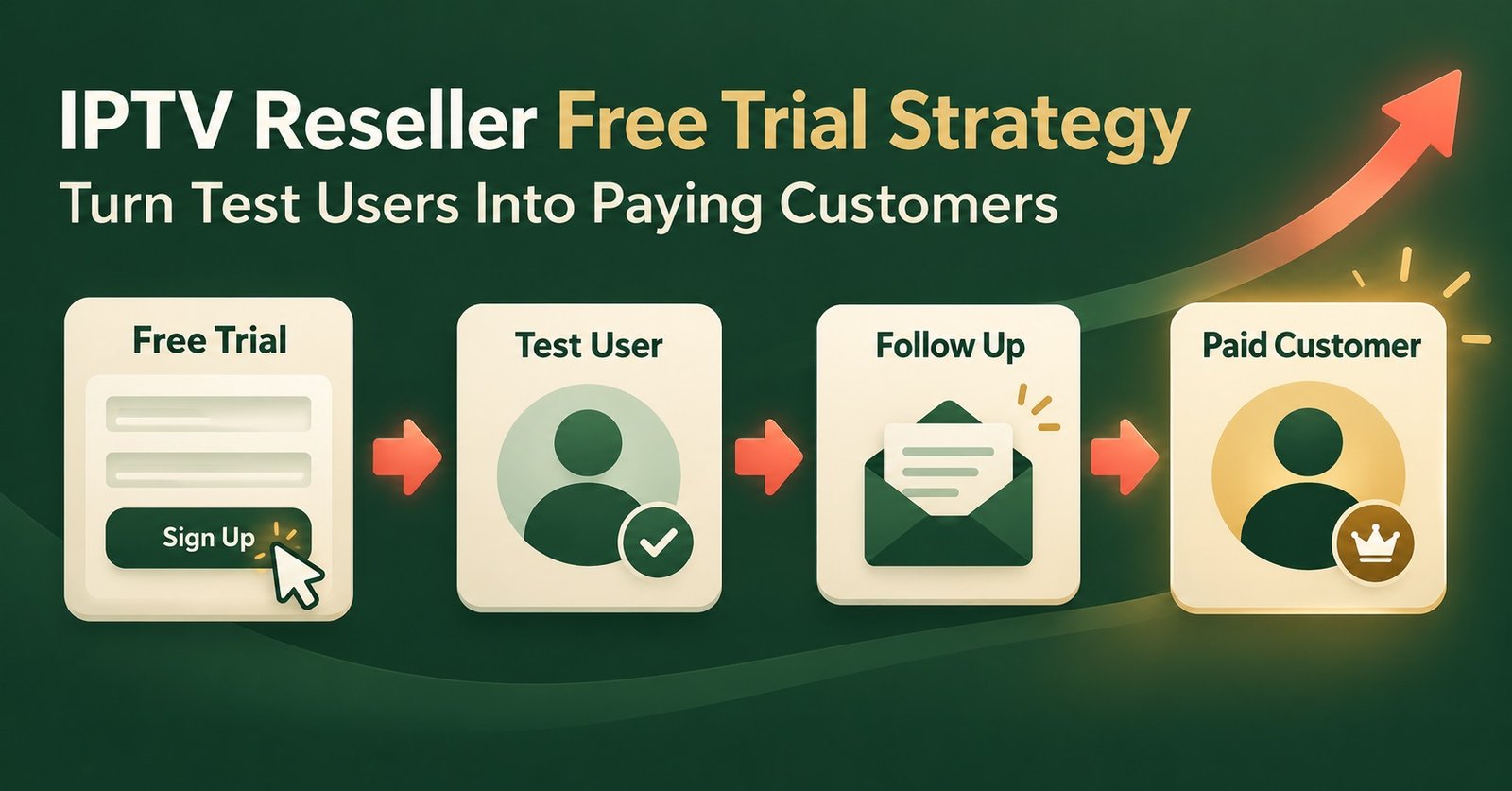
A working IPTV Reseller Free Trial Strategy rests on one decision: what you want the trial to prove. Not what it gives away. If the trial exists to show a prospect that playback is stable on their own device, over their own connection, then it needs to be short, supervised and followed up within hours. Trials that are handed out with no qualification and no return contact almost always end the same way, with an expired line and silence.
What a trial is genuinely meant to prove
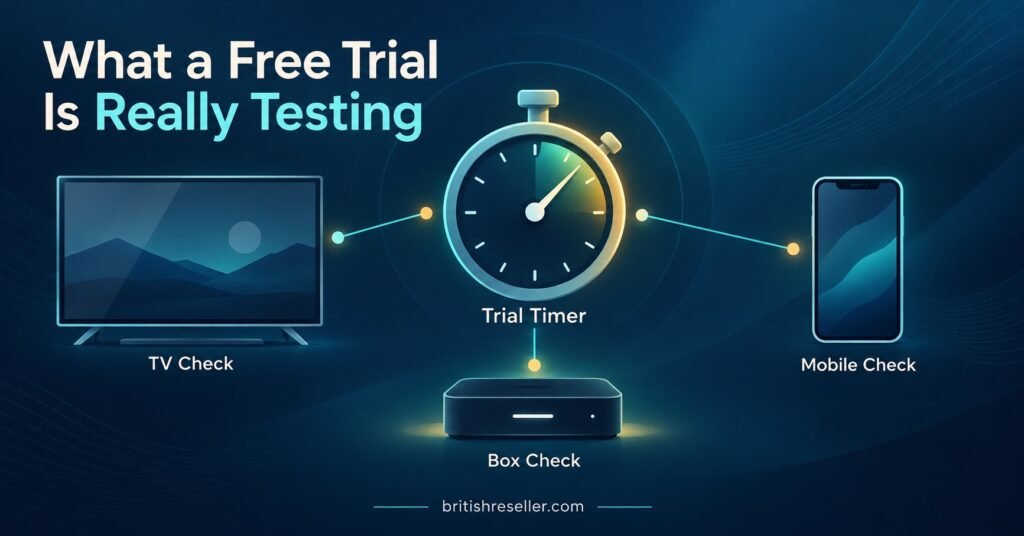
A trial is a demonstration, not a sample of goodwill. The prospect is not testing your pricing or your personality. They are testing whether the service works on the hardware sitting in their living room, on the broadband they already pay for, at the time of day they actually watch.
That narrows things considerably. You are not trying to impress somebody with the size of a catalogue. You are trying to remove one specific doubt, and the doubt is usually technical: will this buffer, will it load on my device, will the app I already have accept these credentials.
Once you accept that framing, most trial decisions become easier. Length, timing, what you send with the credentials, when you follow up, all of it flows from the single question you are trying to close down.
Choosing a trial length you can actually defend
Longer is not more generous. Longer usually means the prospect tests it once, forgets about it, and the line quietly expires while they are busy with something else. Short windows create a reason to act now.
Most IPTV reseller dashboards let you set trial duration in hours rather than days, which is the more useful unit. A window measured in hours forces the prospect to sit down and watch something properly instead of leaving the credentials in a message thread for a week.
There is a sensible exception. If somebody is buying for a household with several devices, or they are evaluating you as a supplier for their own small customer base, a single evening is not enough time to form a judgement. Slightly longer windows are reasonable there, provided you agree the end point out loud rather than letting it drift.
The mistake worth avoiding is running two lengths at once without knowing why. Pick a default, keep a longer version for genuinely different situations, and be able to explain the difference in one sentence.
Pro tip: Set the trial to end at a time you will actually be awake and contactable. A window that expires at three in the morning wastes the one moment when the prospect is most likely to say yes.
Who should receive a trial, and who probably should not
Not every request deserves one. This is the part most guides skip, because saying no feels like losing a sale, but unqualified trials are where reseller time disappears.
A short exchange before you generate anything tells you most of what you need. Ask what device they intend to use, whether they have used a similar service before, and what went wrong with the last one if they had it. Three questions. The answers separate a genuine buyer from somebody collecting free access from every seller they can find.
| Trial request signal | What it usually indicates | Sensible response |
|---|---|---|
| Asks for the trial before asking anything else | Collecting access, not evaluating | Answer questions first, offer trial after |
| Names a specific device and app | Has a real setup and a real intention | Issue promptly with setup instructions |
| Requests multiple trial lines at once | Testing for resale or sharing | Discuss reseller terms instead |
| Vague about how they will watch | Unclear intent, likely low conversion | Qualify further before spending time |
| Mentions a previous supplier and a specific fault | Motivated switcher, high intent | Prioritise and follow up personally |
None of these signals is proof on its own. Somebody can open with a blunt trial request and still become a long term customer. Read them together rather than treating any single line as a verdict.
Pro tip: Keep the three qualifying questions saved as a template message. Sending them takes seconds and gives you a written record of what the prospect said they would use.
The handover is where most trials quietly fail
Credentials on their own are not a demonstration. A username, a password and a server address mean very little to somebody who has never configured a player app, and confusion at this stage reads to them as a fault in your service rather than a gap in the instructions.
Send the credentials with a short setup note matched to the device they told you about. Not a general guide covering nine platforms. One device, the app you recommend for it, and the three fields they need to fill in. If they mentioned a device you are not familiar with, say so honestly and offer an alternative you can support properly.
Timing matters as much as content. A trial issued at midday to somebody who watches in the evening has burned half its life before anyone presses play. Ask when they plan to test, then generate the line close to that point. Panels that create lines instantly make this easy to control, which is one of the practical arguments for understanding how IPTV reseller panelshandle credits and user lines before you build a trial process around them.
Building follow-up into your IPTV Reseller Free Trial Strategy
This is the section that separates resellers who convert trials from resellers who simply issue them.
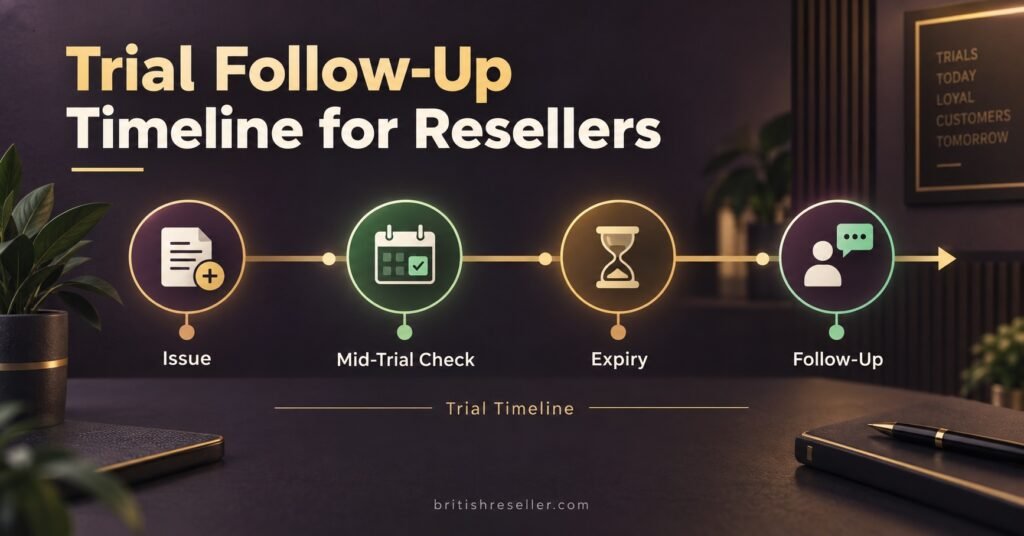
Contact the prospect once during the trial and once shortly after it ends. Not more. The mid-trial message is practical: ask whether the credentials worked and whether anything looked wrong. It catches setup failures while there is still time to fix them, and a fixed problem converts far better than an unresolved one.
The post-trial message is the actual sales conversation, and it should reference something specific from the trial rather than opening with a generic offer. If they told you the previous service froze during evening viewing, ask directly whether that happened this time. That question is much harder to ignore than a price list.
Silence after both messages is an answer. Log it, move on, and do not chase a third time. Persistent chasing damages your reputation in a market where prospects talk to each other.
Recognising trial abuse before it costs you
Some patterns repeat often enough to be worth watching for. The same contact returning under a slightly different name. Requests timed around a specific event rather than general viewing. Several requests arriving from the same source within a short period, each asking for a different device.
Trial generation on most panels does not consume credits, so the direct financial cost is usually low. The real costs are your time, the load your infrastructure carries, and the awkward position of having supported somebody at length who was never going to buy.
Practical controls are simple rather than clever. Keep a record of who you issued trials to and when. Decline repeat trials to the same contact unless there is a clear technical reason. Set duration deliberately instead of leaving whatever default the panel offers. If you run sub-resellers beneath your account, agree the same rules with them, because their trial habits eventually become your infrastructure load.
Pro tip: Before extending a trial for somebody, ask what specifically was not resolved the first time. If they cannot name anything, the extension will not change the outcome.
Working out whether your trial process is earning its keep
You do not need analytics software for this. A simple record of trials issued, trials that reached a follow-up conversation, and trials that converted will tell you more than most dashboards.
Two numbers matter more than the headline conversion figure. The first is how many trials failed at setup rather than at the buying decision, because that points to an instruction problem you can fix this week. The second is how many prospects never replied to either follow-up message, because a high figure there usually means your qualification is too loose rather than your service being weak.
Review those numbers monthly rather than daily. Trial behaviour varies with the season, and one quiet fortnight is not a trend. If the volume of trials you are issuing starts outgrowing the credit spend they produce, the sensible response is usually tighter qualification rather than a shorter trial, though comparing your workload against your actual credit packages and top-up structure is worth doing before you change anything.
Common questions from resellers running trials
Should a trial include the full package or a reduced version?
Give them the same experience they would buy. A reduced trial tests something the customer will never own, and any problem they report afterwards becomes difficult to interpret. If your panel allows bouquet assignment on trial lines, match it to the package you intend to sell them.
What should I do when somebody asks for a second trial?
Ask what went unresolved. Genuine technical faults justify a second attempt, particularly if the first trial was lost to a device or app problem rather than to service quality. A vague request for more time usually means the decision was already made.
Is it worth offering trials to prospective sub-resellers?
Yes, but the trial should demonstrate different things. A sub-reseller cares about dashboard speed, credit visibility and how quickly lines activate, not about how a single stream looks on a television. Giving them access to the tools available inside a IPTV reseller panel answers their questions far better than a viewing trial does.
How much support should I provide during a free trial?
Enough to make the test valid. If somebody cannot connect, the trial has proved nothing and your time is wasted either way. Answering setup questions during the window is reasonable. Rebuilding their entire home network is not.
Do trials work better through messaging apps or a website form?
Messaging tends to convert better because the qualifying conversation happens naturally and the follow-up sits in an existing thread. Forms scale better but produce more unqualified requests. Many resellers use a form to capture the request and messaging for everything after it.
Where this leaves you
An effective IPTV Reseller Panel Free Trial Strategy is mostly about restraint. Short windows, a few qualifying questions, setup instructions matched to one device, and two follow-up messages will outperform generous open-ended trials handed out to anyone who asks. The trial itself is the easy part, since the panel generates the line in seconds. The judgement sits in deciding who receives one and what you do in the hours afterwards.
Start by writing down your default trial length and your three qualifying questions. Once those two things are fixed, the rest of the process has something to hang from, and you can adjust it against real outcomes rather than instinct.
Reseller Trial Checklist
- Agree a default trial length and stick to it unless there is a stated reason to vary it
- Ask about device, previous service and specific faults before generating a line
- Issue the trial close to the time the prospect said they would test it
- Send setup instructions for their device only, not a general guide
- Check in once during the trial to catch setup failures early
- Follow up once after expiry referencing something specific they mentioned
- Record every trial issued, including the ones that went nowhere
- Decline repeat trials where nothing technical was left unresolved
- Apply the same rules to any sub-resellers operating under your account
- Review setup failures and non-replies monthly, then adjust qualification first