

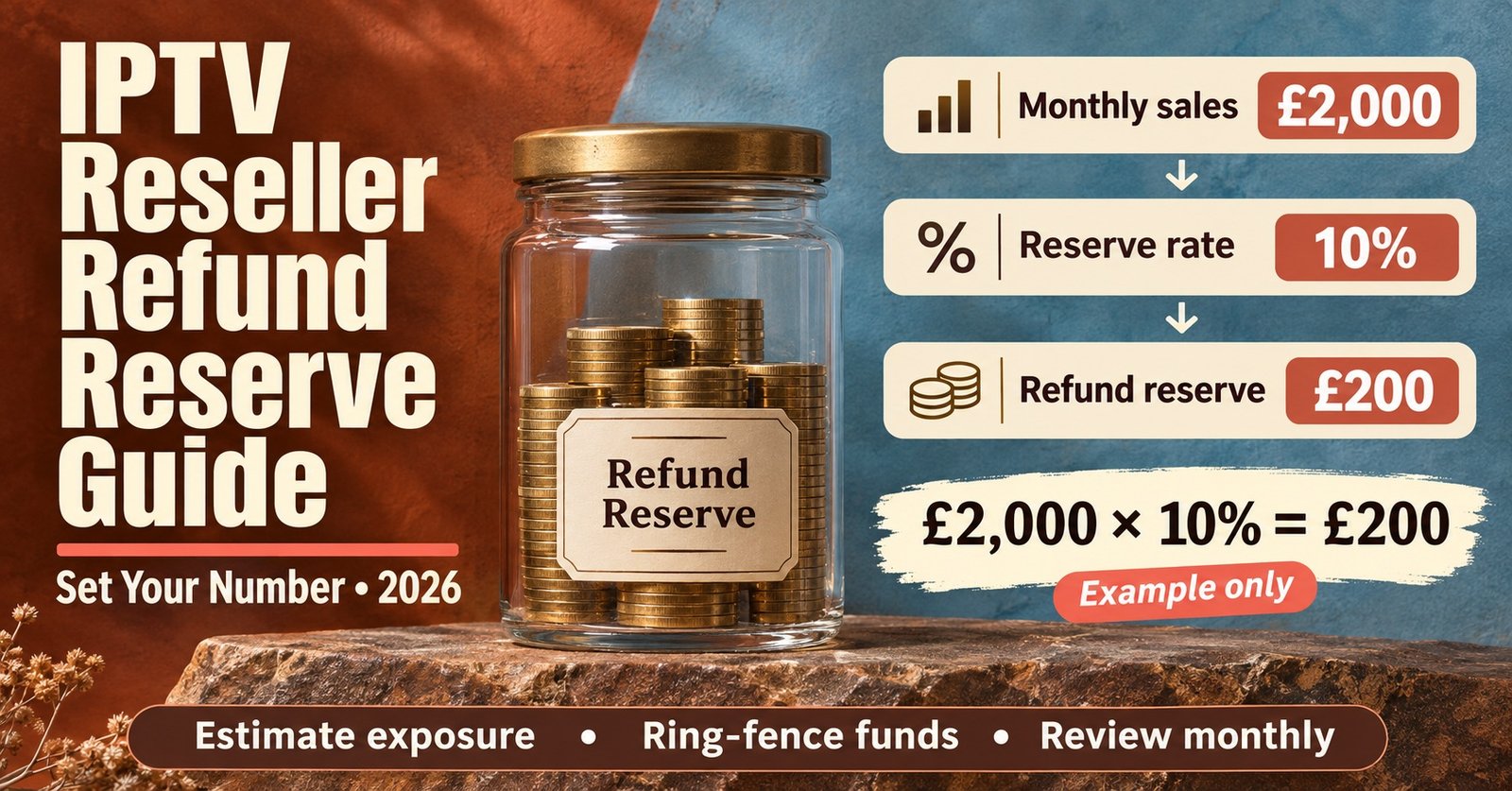
The short version of any IPTV Reseller Refund Reserve Guide is this: hold back enough cash to cover about two months of expected refunds, at least one payment dispute at your largest plan value, and a small share of whatever customers have prepaid on long plans. Then keep that money somewhere you won’t accidentally spend it on credits. The exact figure depends on your own refund history, but the method is simple enough to work out in ten minutes with last quarter’s sales.
The reason it needs its own pot is timing. The credit you used to activate a subscription has already left your business, and most panels won’t hand it back once a line has been running. So when a customer asks for their money weeks later, the refund comes out of your cash, not your provider’s. A reseller who tops up the panel with every spare pound can look perfectly profitable right up to the week three refunds and a card dispute land together.
Where Refund Money Actually Comes From
In a credit-based IPTV panel reseller model, every sale has two halves. You receive the customer’s payment, and you spend credits to create or extend their line. Those credits are a sunk cost the moment the line goes live.
That changes the arithmetic of a refund. If a customer pays £10 for a month and the credit cost you £2, your margin on that sale is £8. Refund the full £10 and you haven’t simply lost the £8 margin; you’ve lost £2 more, because the credit stays spent. On a twelve-month plan, the gap between what the refund costs you and what you earned can be much wider.
Some panels do return credits if a line is deleted within a short window after creation. Check how yours behaves rather than assuming it, and treat any such window as a bonus, not as part of your reserve. If you’re still comparing suppliers, a clear written refund position from the provider is one of the practical checks before you choose an IPTV provider.
What the Reserve Has to Cover
A refund reserve isn’t only for “I changed my mind” requests. In practice it absorbs several different kinds of money leaving the business:
- Cancellations within any cooling-off period your terms and local consumer law allow
- Partial refunds when a service problem affected part of a paid period
- Goodwill credits or refunds you choose to give to keep a long-standing customer
- Card disputes and chargebacks, which usually arrive with a processing fee on top
- Duplicate or mistaken payments that need returning
Consumer law in the UK and many other English-speaking markets gives buyers rights when a digital service isn’t as described, and your terms can’t remove those rights. Write a refund policy that is clear about timescales and partial refunds, and take proper advice on the wording. A clear policy tends to reduce disputes, because customers who know the route to a refund are less likely to go straight to their card issuer.
One distinction worth making early: some payment processors hold back a percentage of your settlements as their own rolling reserve. That money protects the processor, not you, and it isn’t available for refunds. Don’t count it as part of your reserve.
It also matters what you are selling. A reserve is a cash-flow tool; it doesn’t make a service legitimate. IPTV is a delivery technology, and lawful use depends on the content being properly licensed for distribution. Refund and dispute rates tend to be hardest to manage where that question hasn’t been answered.
IPTV Reseller Refund Reserve Guide: The Formula
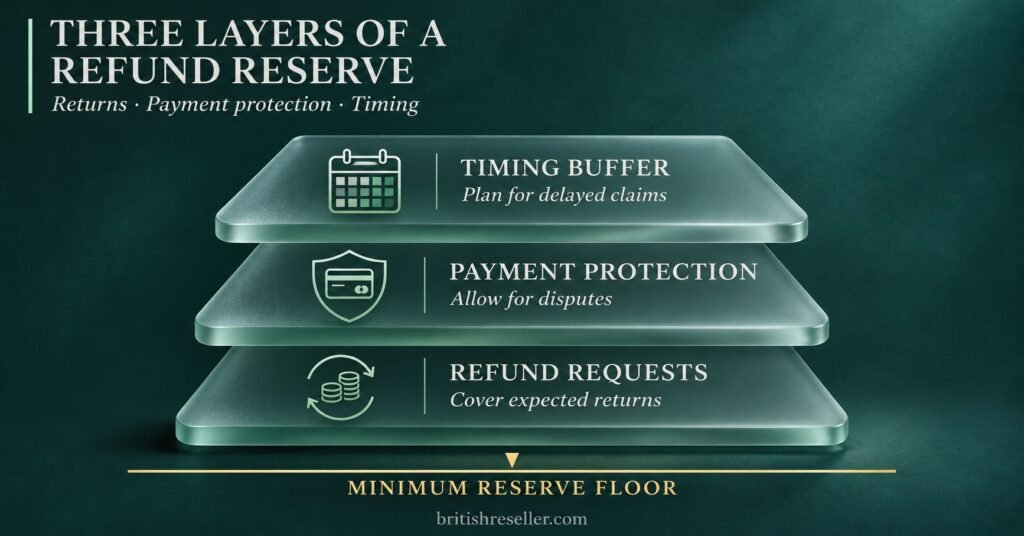
The reserve is easiest to build in three layers, plus a floor.
Layer 1, routine refunds. Average monthly revenue × your refund rate × 2. The refund rate is refunds paid divided by revenue over the last three to six months. The multiplier of two covers the lag between a sale and a complaint, and gives you breathing room if a bad week hits.
Layer 2, disputes. Expected disputes over the next two months × (your largest common plan price + your processor’s dispute fee). Use the fee in your merchant agreement, not a guess. If you’ve never had a dispute, plan for at least one anyway.
Layer 3, prepaid exposure. Unearned value on active long plans × your refund rate. Unearned value is the part of a prepaid plan the customer hasn’t used yet. A customer six months into a twelve-month plan has six months of unearned value sitting with you.
The floor. Whatever the formula says, never let the reserve fall below the value of your two most expensive plans. Small IPTV panel resellers with low volume can otherwise end up with a reserve too thin to handle a single annual refund.
Your reserve is the larger of (Layer 1 + Layer 2 + Layer 3) and the floor, rounded up.
A Worked Example With Every Assumption Shown
The figures below are illustrative, not market data. Swap in your own from your sales records and panel history.
| Item | Assumed figure | Where it comes from |
|---|---|---|
| Monthly plans sold | 120 at £10 | Sales records |
| Quarterly plans sold | 15 at £27 | Sales records |
| Annual plans sold | 6 at £90 | Sales records |
| Credit cost | £2 per credit | Your panel pricing |
| Refund rate | 3% of revenue | Last 3 to 6 months |
| Dispute fee | £15 (placeholder) | Merchant agreement |
| Expected disputes | 1 in two months | History, minimum of 1 |
Monthly revenue comes to £1,200 + £405 + £540 = £2,145. Credit spend is 120 + 45 + 72 = 237 credits, or £474.
Layer 1: £2,145 × 3% × 2 = £128.70.
Layer 2: one dispute on the largest plan, £90 + £15 = £105.
Layer 3 needs a little more thought. Selling six annual plans a month in a steady state means roughly 72 annual customers are active at once, and on average each has about six months left. At £7.50 a month, that’s 72 × 6 × £7.50 = £3,240 of unearned value. Apply the 3% refund rate and you get £97.20. (Quarterly plans add a small amount too; for clarity it’s left out here, but include it in your own sum.)
Total: £128.70 + £105 + £97.20 = £330.90. The floor is two annual plans, £180, so the layered figure wins. Round up to £350.
That’s about 16% of one month’s revenue in this example. It isn’t a benchmark. A reseller selling mostly monthly plans by bank transfer might need far less; one leaning heavily on annual card payments could need considerably more.
Why Annual Plans Change the Picture
Long plans are good for cash flow on the day they’re sold, which is exactly why they need care. In the example, £540 of annual sales arrives in one month, but only £45 of it is earned that month. The rest is a promise you still have to keep.
If a customer cancels four months into an annual plan and your policy allows a pro-rata refund, you could owe them £60 while the twelve credits you spent are long gone. Multiply that across a bad month and the hit is noticeable.
Two habits help. First, track unearned value as a running figure rather than working it out only when someone asks for money back. Second, make your partial refund method explicit in your terms (for example, whole unused months only), so every refund is calculated the same way. Most panels show line expiry dates, which makes the first habit easier; the credit management and expiry controls in the reseller panel give you the remaining months for each customer without a separate spreadsheet.
Pro tip: Recalculate Layer 3 whenever annual plans make up a noticeably bigger share of the month’s sales than usual, such as after a seasonal promotion. That’s when prepaid exposure jumps fastest.
Adjusting the Reserve to Your Situation
The formula gives a starting number. Your circumstances should move it up or down.
| Situation | Adjustment | Reason |
|---|---|---|
| New reseller, under three months of data | Use the floor or a 5% refund rate, whichever is higher | No reliable history yet |
| Mostly card payments | Add one extra dispute to Layer 2 | Disputes are only possible on card-type payments |
| Mostly bank transfer | Layer 2 can be smaller | No chargeback route, though mistaken payments still happen |
| Heavy annual plan sales | Review Layer 3 monthly | Unearned value grows quickly |
| Sub-resellers selling under you | Add their exposure if you refund on their behalf | Agreements decide who pays |
| Recent supply or service disruption | Temporarily double Layer 1 | Refund requests cluster after problems |
Sub-reseller arrangements deserve a written answer before anything goes wrong. If a sub-reseller’s customer disputes a payment made to the sub-reseller, the money normally leaves their account, not yours. But if you’ve agreed to cover refunds when your supply fails, that exposure belongs in your reserve. Put the rule in writing either way.
Trials also feed into this. Customers who have tested a service properly before paying are less likely to ask for money back in the first week, so a well-run IPTV reseller panel free trial strategy is partly a refund-prevention tool.
Where to Keep It and When to Touch It
The reserve works only if it’s genuinely separate. A second business bank account, or at least a clearly named savings pot, stops it blending into the money you use for credit top-ups.
Set three rules and stick to them. Refunds and dispute debits come out of the reserve; nothing else does, especially not credit purchases. After any withdrawal, top it back up from the next income before buying more credits. And recalculate the target once a month, releasing any surplus only when the new figure is lower for two months running, so a single quiet month doesn’t tempt you to drain it.
Buying credits in bulk can sit comfortably alongside this. Because credits on britishreseller.com don’t expire, there’s no pressure to spend reserve money just to use a balance before it lapses. The reserve stays as cash, and the credit balance stays as stock.

The Numbers Worth Checking Every Month
A reserve is only as good as the figures feeding it. A short monthly review keeps it honest:
- Refund rate: refunds paid ÷ revenue, tracked on a rolling three-month basis so one odd month doesn’t distort it.
- Reserve coverage: reserve balance ÷ refunds and dispute debits over the last 60 days. Below 1.0 means the reserve couldn’t have absorbed a repeat of the last two months.
- Disputes per 100 card payments: a rising number usually points to unclear billing descriptors, unmet expectations or slow support responses.
- Refund reasons: grouped into setup trouble, service problems, changed mind and payment errors. If setup trouble dominates, better onboarding will save more money than a bigger reserve.
- Unearned value on long plans: the Layer 3 input, updated from line expiry dates.
- Drawdowns: how many times you dipped into the reserve and how quickly it was refilled.
The refund reasons figure is often the most useful of the lot. A reserve handles the cost of refunds; the reasons tell you how to have fewer of them.
Frequently Asked Questions
Should I count unused panel credits as part of my refund reserve?
No. Credits are stock you can only use to create or extend lines; they can’t be paid back to a customer. Keep the reserve as cash.
What refund rate should I use if I’ve never given a refund?
Use a cautious placeholder, such as 5%, until you have at least three months of real data, and never let the reserve fall below the value of your two most expensive plans.
Does accepting bank transfers instead of cards remove the need for a reserve?
It removes the chargeback route, so Layer 2 can shrink, but cooling-off cancellations, service-related partial refunds and mistaken payments still happen. You still need Layers 1 and 3.
How often should the reserve target be recalculated?
Monthly is enough for most resellers, with an extra check after any service disruption or a month with unusually high annual plan sales.
Who refunds a sub-reseller’s customer?
Normally whoever received the payment, but your agreement with the sub-reseller decides it. If you’ve agreed to cover refunds caused by supply problems on your side, include that exposure in your own reserve.
Making the Reserve Part of Normal Operations
The real point of an IPTV Reseller Refund Reserve Guide is that refunds stop being an emergency. Work out the three layers from your own records, set the floor, park the money in a separate account, and refill it before you buy more credits. The figure won’t be perfect at first, especially without much history, so err on the cautious side for the first few months and let your refund rate and coverage ratio pull it towards the right level. Start by exporting last quarter’s sales and refunds this week; that single spreadsheet gives you every number the formula needs.