

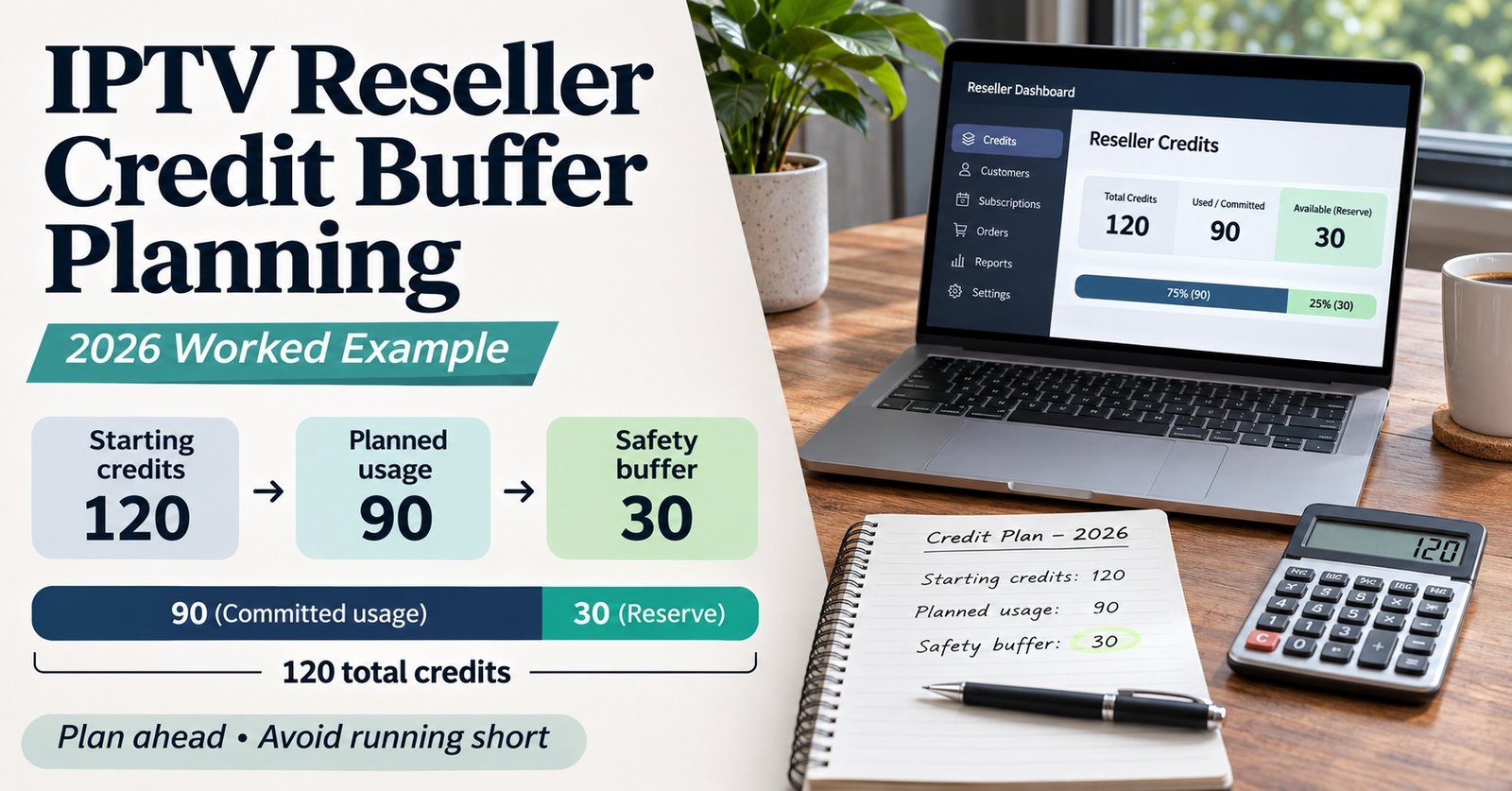
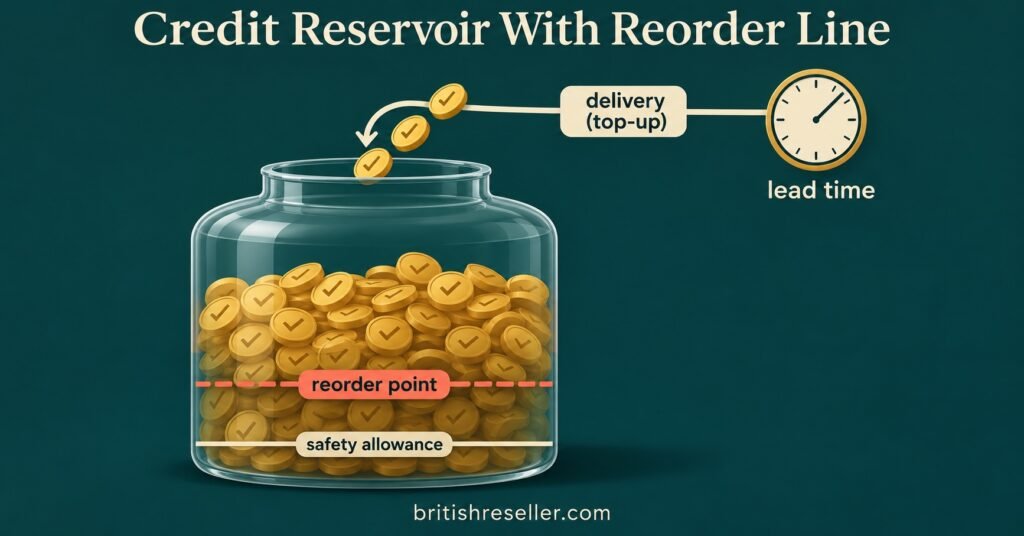
IPTV Reseller Credit Buffer Planning comes down to one number you can act on: the reorder point. Take your average daily credit use, multiply it by the number of days a top-up realistically takes to become usable, then add any large renewals already scheduled inside that window plus a small safety allowance. When your balance falls to that figure, you buy. Fall below it and a single busy evening of renewals can leave a paying customer waiting while you chase a payment confirmation.
The balance on your dashboard isn’t your buffer, though. Part of it already belongs to customers whose lines expire this month, and on a panel that charges one credit per month of service, an annual subscriber renewing on a Saturday takes twelve credits in one deduction. The useful figure is what remains once the renewals you can already see have been paid for. Measured against how quickly you can restock, that remainder tells you whether you’re comfortable or one bad weekend away from a shortfall.
Committed Credits and Free Credits
Every IPTV reseller panel balance has two parts, even though the panel shows a single number. Committed credits are the ones your existing customers will consume when their lines come up for renewal. Free credits are whatever is left after that. Only the free portion protects you against surprises.
You can work out the split from the expiry dates in your reseller dashboard. Most panels let you sort or filter lines by expiry, so pull the list for the next 30 days and add up what each renewal will cost in credits. A monthly line costs one, a three-month line three, an annual line twelve, assuming the common one-credit-per-month model. Then apply a simple formula:
Free credits = current balance − credits needed for renewals due in the next 30 days
Should you discount that renewal figure for customers who won’t come back? For buffer purposes, no, or only lightly. Over-estimating demand costs you a little idle cash. Under-estimating it costs you a customer whose service lapsed because you couldn’t renew them on time. If you track your renewal rate over the last few months, you can trim the figure modestly, but treat it as a refinement rather than the starting point.
The Three Numbers Behind IPTV Reseller Credit Buffer Planning
Daily credit burn
There’s a handy shortcut here. On a one-credit-per-month model, every active line consumes, on average, one credit per month regardless of whether the customer pays monthly, quarterly or annually. A hundred active lines will average roughly a hundred credits a month in renewals if everyone renews. Add the credits you typically spend on new customers, divide by 30, and you have your daily burn.
The average hides the timing, which is where most shortfalls come from. That’s covered below.
Top-up lead time
This is not your provider’s advertised activation speed. It’s the full gap between your balance reaching the danger line and new credits being usable in the panel. That includes how often you actually look at the balance (once each evening adds up to a day), how long your payment method takes to clear, how quickly the provider confirms, and whether weekends or time zone differences slow any of those steps. Plan for the worst ordinary case you’ve seen, not the best one.
Scheduled lumps
Annual and quarterly renewals, sub-reseller top-up requests and planned promotions all arrive as chunks rather than a steady trickle. They’re predictable if you look at the calendar, and dangerous if you rely only on averages.
Put together, the basic formula looks like this:
Reorder point = (daily burn × lead time in days) + safety allowance
For the safety allowance, a simple rule works for most small operations: one extra lead time’s worth of burn, or your largest single day of new sales in recent months, whichever is bigger.
A Worked Example With the Assumptions Shown
The figures below are hypothetical and chosen to make the arithmetic easy to follow. Swap in your own numbers.
- 120 active lines: 70 monthly, 35 on three-month terms, 15 annual
- The panel charges one credit per month of service
- Around 20 credits a month go on new customers
- Top-ups usually land within a day, but the balance is checked once each evening and the provider responds more slowly at weekends, so the realistic lead time is three days
- The busiest day for new sales in recent months used 8 credits
| Step | Calculation | Result |
|---|---|---|
| Daily burn | (120 renewal credits + 20 new) ÷ 30 | about 5 credits a day |
| Lead time demand | 5 × 3 days | 15 credits |
| Safety allowance | larger of 15 (another lead time) or 8 (busiest day) | 15 credits |
| Static reorder point | 15 + 15 | 30 credits |
Thirty credits looks reasonable until you open the expiry list. Suppose the next six days (the lead time plus the safety window) contain 14 monthly renewals, 4 three-month renewals and 2 annual renewals. That’s 14 + 12 + 24 = 50 credits, plus roughly 4 for new sales over the same six days. The real requirement this week is about 54 credits, nearly double the static figure.
So the working rule is a rolling check: calculate the static reorder point, then compare it with the credits actually due in the next lead time plus safety window, and use whichever is higher. A book made up mostly of monthly customers will rarely see much difference. A book with a meaningful share of annual lines will, and the difference is exactly where a weekend shortfall comes from.
How much to buy when you hit the reorder point is a separate question. A straightforward approach is to cover your expected use until the next planned purchase, add back the safety allowance, and subtract what you already hold. If you top up monthly in this example, that’s 140 + 15 − 54, or about 101 credits, rounded up to the nearest package your provider sells.
Pro tip: Write the rolling check into your calendar as a fixed weekly task, ideally on Thursday, so any top-up it triggers has time to clear before the weekend.
Where Renewal Calendars Bunch Up
Lumps rarely appear at random. They usually trace back to something you did months earlier.
A promotion run in a particular month creates a cohort of customers who all signed up at once. If many took annual terms, that same month next year becomes a heavy renewal period, and it can catch you out because nothing unusual is happening in the business right now. The same applies, on a smaller scale, to three-month cohorts.
Monthly customers may also cluster around paydays, depending on who you sell to. Your expiry list will show whether that’s true for your book. Bank holidays deserve attention for a different reason: demand carries on while payments, provider responses and your own availability can all slow down, so the lead time effectively stretches just as the buffer is being drawn.
Then there are the costs people forget to count. Check whether your panel deducts anything for trial lines, extra connections or replacement lines created during a support issue. If it does, those belong in your daily burn figure too.
Deciding How Deep the Buffer Should Be
There’s no single correct buffer size. The right depth depends on how predictable your demand is and how reliable your restocking is.
| Your situation | Buffer approach | Reason |
|---|---|---|
| Mostly monthly customers, steady sales | Static reorder point is usually enough | Demand is smooth, so the average reflects reality |
| A large share of annual or three-month lines | Always run the rolling expiry check | Single deductions of 3 or 12 credits distort the average |
| Active sub-resellers drawing from you | Add their average weekly request, or cap allocations | Their demand isn’t visible in your own expiry list |
| Slow or manual top-ups | Lengthen the lead time to the worst ordinary case | A short lead time assumption is the most common error |
| Provider reliability not yet proven | Keep the buffer lean and top up more often | Stockpiled credits carry the provider’s risk |
| Promotion planned | Build the buffer up a week before launch | New sales arrive faster than any average predicts |
If two rows apply, use the more cautious approach for the first and the leaner one for the second. A IPTV reseller with many annual lines and an unproven provider, for instance, should run the rolling check every week but buy smaller amounts more often.
What a Buffer Costs to Hold
A buffer is insurance, and insurance has a price. The obvious cost is cash. Credits sitting in a panel are money you can’t spend on anything else, and for a small operation that matters more than the per-credit saving on a bigger package.
Non-expiring credits remove one risk, wastage, but not the others. Look carefully at refund terms before you buy ahead of need. On britishreseller.com, for example, the refund and exchange policy for credit packages treats standard credit purchases as final, allows refunds or exchanges only on specific eligible packages, and never refunds credits already used. Terms differ between providers, but the general point holds: an over-purchase is often hard to unwind.
The less obvious cost is concentration. Your credits only have value while the provider behind them continues to operate and support your panel. Holding several months of stock with one provider is a bet on that provider, so the size of the bet should match how much evidence you have about its reliability.
Volume pricing pulls in the other direction. Larger bundles commonly cost less per credit, and you can compare the tiers on the reseller credit pricing page. A useful test before moving up a tier: divide the bundle size by your monthly burn to see how many months of cover you’d be buying, then ask whether you’d be comfortable with that much cash committed to one provider for that long. If the answer is no, the discount isn’t worth it yet.

Sub-Resellers Draw on the Same Pool
If you run sub-resellers, credits you allocate to them usually leave your balance at the moment of transfer. Whatever they haven’t sold sits in their account, not yours, so it doesn’t help you cover your own renewals. Two IPTV panel resellers can each believe they have slack when the combined position is tight.
Treat sub-reseller requests as scheduled demand rather than surprises. Agree how much notice they give before asking for more, look at their average weekly request, and add it to your burn figure. Allocation caps help here as well, because they stop one large request from emptying your free credits in a single transfer. The guide to setting sub-reseller limits safely covers how to structure those controls.
The relationship also runs the other way. If you’re a sub-reseller yourself, your lead time isn’t the provider’s activation speed. It’s how quickly your parent reseller responds to a request, which may be slower in the evening or at weekends. Build your reorder point around that.
Numbers Worth Checking Each Week
A buffer plan only works if you look at it regularly. These figures take a few minutes to update and tell you whether the plan still fits the business:
- Days of cover: free credits divided by daily burn. Falling cover with steady sales means renewals are bunching.
- This week’s reorder point: the higher of the static figure and the rolling expiry check.
- Actual lead time on the last top-up: if it took longer than your assumption, raise the assumption.
- Near misses: any renewal delayed, even briefly, because the balance was short. One near miss is a signal to recalculate.
- Renewal rate: useful for refining the committed credits figure once you have a few months of data.
- Balance against records: your panel balance should match your own ledger before you trust any of the numbers above.
That last point is easy to skip and expensive to get wrong. If transfers, refunds or manual adjustments haven’t been recorded, your free credits figure is fiction. The routine for credit reconciliation with sub-resellers is worth running before the weekly buffer check, not after.
Questions Resellers Ask About Credit Buffers
Do non-expiring credits mean I should buy as many as I can afford?
Not necessarily. Non-expiring credits remove the risk of losing unused stock to a deadline, but they don’t remove the cash commitment, the refund limitations or the dependence on one provider. Buy enough to cover your planned purchase cycle plus the safety allowance, and move to larger bundles only when the months of cover they represent feel comfortable.
How often should I recalculate the reorder point?
Weekly is sensible for most resellers, with an extra check before bank holidays and before any promotion. Recalculate immediately if your sales pace changes noticeably, a top-up takes longer than expected, or you add a sub-reseller.
Should a brand new reseller with only a few lines bother?
Yes, but keep it simple. With a small book, a single annual renewal can be a large share of your monthly use, so the rolling expiry check matters even more than the averages. A ten-minute look at the next fortnight’s expiry dates is usually enough.
What should I do if the balance is already below the reorder point?
Top up first, then work out why. The usual causes are an optimistic lead time, a renewal cohort you hadn’t spotted, an unrecorded sub-reseller transfer, or new sales running ahead of the estimate. Correct the assumption that failed so the same gap doesn’t reopen next month.
Building IPTV Reseller Credit Buffer Planning Into Your Routine
IPTV Reseller Credit Buffer Planning isn’t about holding as many credits as possible. It’s about knowing, each week, how many of your credits are genuinely free and whether that’s enough to cover the time it takes you to restock. The static reorder point gives you a quick baseline; the rolling check against your expiry list catches the annual and quarterly lumps that averages miss. Neither replaces judgement about cash and provider risk, and your numbers will only be as good as the records behind them.