

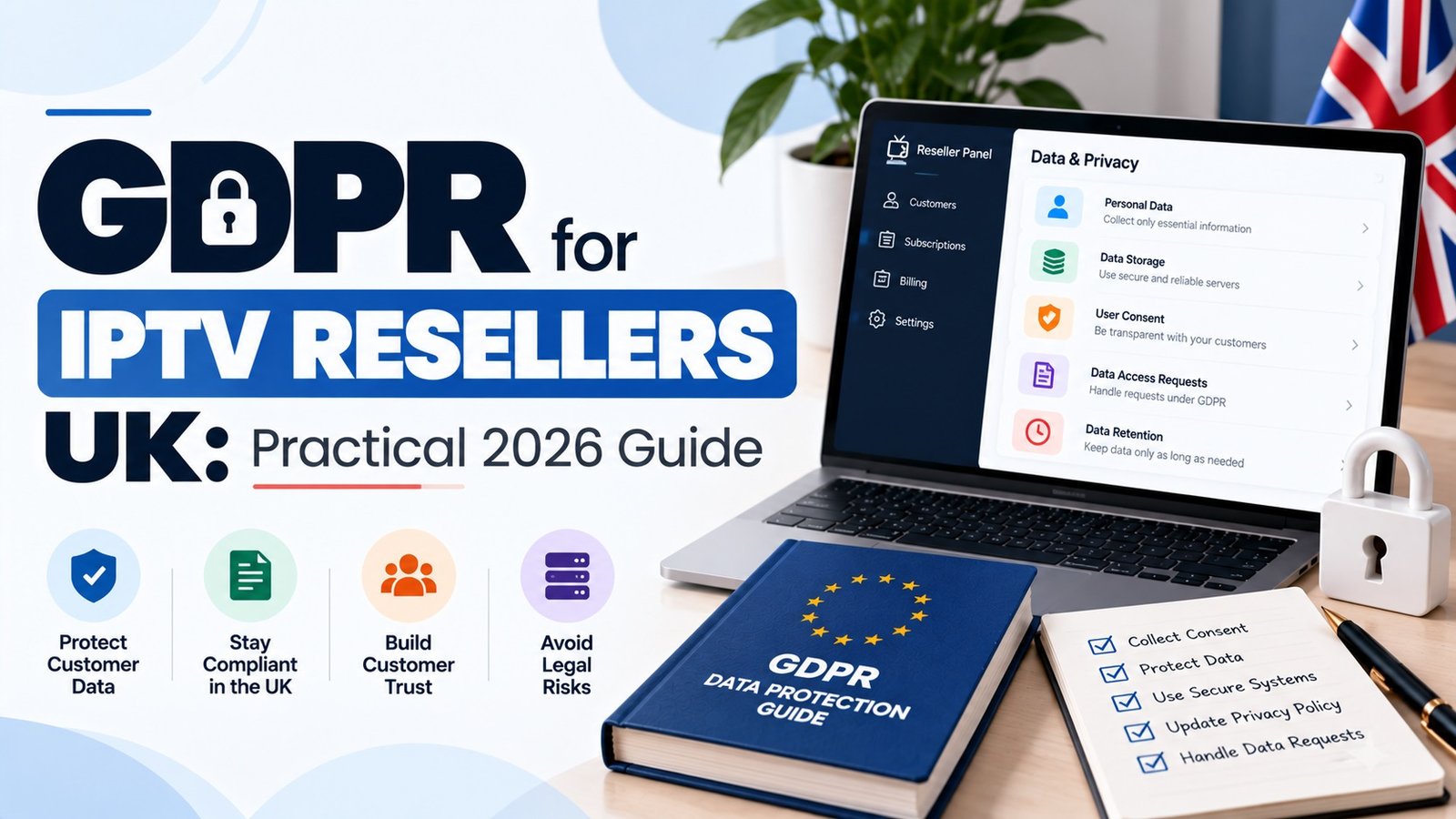
GDPR for IPTV Resellers UK comes down to a simple test: if you hold customer names, email addresses, payment records or connection details, you are almost certainly a data controller under UK GDPR, and the rules apply however small your customer base is.
Most resellers do not get caught out by the headline rules. They get caught by loose ends, such as a customer list buried in a chat history, a panel login shared with a helper, or no ICO registration because nobody thought a small reselling business counted. Before anything else, check three things: whether you must pay the ICO data protection fee, whether you have a written privacy notice, and what your panel provider has agreed in writing about customer data.
Start with a data map, not a policy template
You cannot protect or delete data you have not found, so the first job is a plain list of where customer information sits. For a typical reseller that is more places than expected. The panel holds usernames, expiry dates, device names, notes and connection records, and an IP address linked to a person is personal data. Your payment processor holds billing details. Your support inbox and messaging apps hold names, phone numbers and often a full history of credentials sent to customers. Then there are spreadsheets, exported lists and backups that nobody remembers creating.
Once the list exists, put a retention decision next to each item. A line that expired three years ago does not need the customer’s phone number, device notes and full chat history sitting around indefinitely. Keep what you genuinely need for accounting, disputes and support, and delete the rest on a schedule you can explain.
Pro tip: Keep the data map to one page with four columns: where the data sits, what it contains, who can access it and when it is deleted. Reviewing one page every few months is realistic. Reviewing a thirty-page policy is not.
Who is responsible when the panel, the reseller and the sub-reseller all touch the same record
UK GDPR splits responsibility between controllers, who decide why and how personal data is used, and processors, who handle it on a controller’s instructions. In most reselling set-ups you are the controller for your own customers. Your panel provider usually acts as a processor for line data held on your behalf, although for your own account details, such as your name and billing information, the provider is more likely a controller in its own right. Payment processors typically sit in the controller category as well. Roles depend on the facts, so do not assume them from a job title.
Where a controller uses a processor, Article 28 requires a contract or other binding terms. The ICO’s guidance expects those terms to cover things such as acting only on documented instructions, confidentiality for anyone with access, security measures, rules on engaging sub-processors and deleting or returning data at the end of the relationship. If your provider cannot point you to written data processing terms, treat that as a real warning sign rather than a paperwork gap.
Sub-resellers add a further layer. A sub-reseller who decides what customer data to collect and how to use it is normally a controller for those customers, which means they need their own notice, their own fee check and their own breach process. If you hand them dashboard access, the permission controls matter. Review what a panel allows you to restrict, such as the options described on the IPTV reseller panel features page, and give each person only the access their job needs.

What GDPR for IPTV Resellers UK means for your paperwork
Three pieces of paperwork do most of the work. The first is the ICO data protection fee. Controllers must pay unless an exemption applies, and the fee depends on staff numbers and turnover. The current tiers are £52, £78 and £3,763, with a £5 discount for paying by direct debit, and the ICO’s own self-assessment tool will tell you which applies. Treat that tool as the authority for your situation, as sole traders and small companies often assume they are exempt without checking.
The second is a privacy notice written for your actual customers. It should say who you are, what you collect, why, which lawful basis you rely on, who receives the data (your panel provider and payment processor, for example), how long you keep it, what rights people have and how to complain. Put it somewhere easy to find, in the way the privacy policy page on British Reseller sits among a site’s standard links. A notice hidden behind three clicks does not do its job.
The third is knowing your lawful basis for each activity. Delivering the service a customer ordered usually rests on contract. Keeping invoices and accounting records rests on legal obligation, and your accountant can tell you how long those need to be retained. Fraud prevention and account abuse checks can often rely on legitimate interests, provided you have weighed them against the customer’s rights. Marketing is different, and the next section explains why.
Renewal reminders, offers and the marketing rules under PECR
A message telling a customer their line expires on Friday is a service message. A message offering a discount on a longer plan is marketing. The distinction matters because marketing by email, text or messaging app is covered by the Privacy and Electronic Communications Regulations, and since 5 February 2026 the maximum penalty for breaching those marketing rules has matched the UK GDPR ceiling of £17.5 million or 4% of worldwide turnover, whichever is higher. The ICO has long been active on PECR, so the old habit of treating it as a minor rulebook is out of date.
For existing customers, the soft opt-in can allow marketing of similar products without fresh consent, but only if the person was offered a simple way to refuse when their details were collected and is offered that option in every message. For people who were never customers, such as someone who asked for a trial, assume you need consent before sending promotions. Bought or scraped contact lists are a problem you do not want.
How breaches really happen in reselling, and what the 72 hours mean
A personal data breach is not only a hack. It covers accidental loss, alteration or unauthorised disclosure of personal data, as well as unauthorised access. In reselling the realistic causes are ordinary: credentials sent to the wrong person, a former helper whose panel login was never removed, or a spreadsheet shared through an open link.
If a breach is likely to result in a risk to people’s rights and freedoms, the controller must tell the ICO without undue delay and, where feasible, within 72 hours of becoming aware of it. If the risk is high, affected individuals must be told too. Every breach, reportable or not, should be recorded internally with the reasoning behind your decision. Processors must notify the controller without undue delay, and a controller is generally treated as aware once its processor tells it.
| Situation | How to treat it | First move |
|---|---|---|
| Credentials sent to the wrong customer | Likely a breach, as one person’s line details were disclosed without authority | Change the password, contact the recipient, log it, then assess risk |
| Former helper still has panel access | An access weakness, and a breach only if it was misused | Remove access, check logs for activity, record the review |
| Customer spreadsheet shared by open link | Possibly a breach if anyone unauthorised could view it | Close the link, check access history, decide on ICO notification |
| Provider reports a database incident | Provider must tell you without undue delay, and your timeline runs from awareness | Request details, assess risk to your customers, decide on reporting |
Pro tip: Agree with your provider, before anything goes wrong, how quickly and through which channel they will tell you about an incident. A vague promise to “let you know” is not much use at two in the morning.
When a customer asks for their data, or complains
A subject access request lets a person ask what you hold about them, and you generally have one month to respond. That can be extended by up to two further months where the request is complex or numerous, and the clock can be paused while you reasonably wait for identity checks or clarification. The Data (Use and Access) Act 2025 put the long-standing ICO position into law that searches need only be reasonable and proportionate, which helps small businesses but does not excuse ignoring a request. Remember that a chat history with a customer can be in scope.
Deletion requests are not automatic wins either. You may keep records you need to meet a legal obligation or to deal with a legal claim, and you can explain that clearly while deleting everything else.
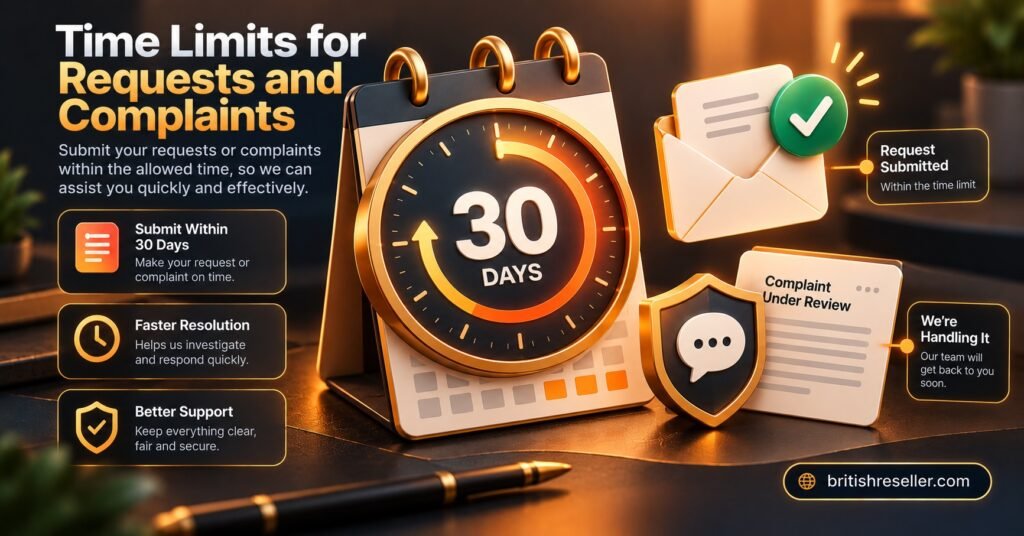
Since 19 June 2026, controllers must also have a way for people to complain to them directly about data protection. That means a visible route, such as a form or a named contact, acknowledgement of the complaint within 30 days, and handling it without undue delay with the outcome communicated. Add it to your support process and your privacy notice now if you have not already.
Overseas hosting and the questions to put to your provider
Many panels, servers and support tools sit outside the UK, and sending UK customers’ personal data abroad needs a lawful transfer route. The ICO now describes the assessment of a destination country’s protection as a data protection test, replacing what was previously called a transfer risk assessment. You do not need to run one alone: ask your provider where customer data is stored, which sub-processors it uses and what safeguards cover transfers. If you also serve customers in the EU, EU GDPR can apply alongside UK rules, and other English-speaking countries have their own laws. This article covers the UK position only.
What compliance does not settle
Data protection law deals with how personal data is handled. It says nothing about whether the content a service delivers is properly licensed. IPTV is a delivery technology, and the legality of any content depends on rights, permissions and local requirements. A clean privacy notice is not evidence that a service is authorised, so IPTV panel resellers should check rights and permissions separately.
Questions resellers ask
Do I need to register with the ICO if I only have a few dozen customers?
Possibly. The fee depends on whether you are a controller, your staff numbers, turnover and any exemption, not on customer count alone. Use the ICO’s fee self-assessment to get a definite answer.
Can I keep customer details after a line expires?
Only for as long as you have a reason you can justify, such as accounting records, a dispute window or a legitimate follow-up. Decide the period in advance and state it in your privacy notice.
Do my messaging app chats count when I answer an access request?
They can. If the chats contain a person’s personal data and are within your control, a reasonable and proportionate search should consider them.
Does a sub-reseller need their own privacy notice?
If they decide how their customers’ data is used, they are normally a controller and should have one. Your notice does not automatically cover their customers.
Do I still need to follow UK rules if my customers are mostly abroad?
If you are established in the UK, UK GDPR can still apply to how you process data. If customers are in other regions, local laws may apply as well, so take advice on each market.
Reseller Compliance Checklist
- Draw up a one-page map of every place customer data is stored
- Run the ICO fee self-assessment and record the result
- Obtain written data processing terms from your panel provider
- Publish a privacy notice that names your processors and retention periods
- Remove panel access for anyone who no longer needs it
- Write a short breach procedure with the 72-hour decision point
- Set up a visible complaints route that acknowledges within 30 days
- Separate renewal reminders from promotional messages and offer opt-outs on the latter
Where to start this week
GDPR for IPTV Resellers UK is manageable when you treat it as a handful of habits rather than a legal project. Know where customer data sits, confirm your role and your provider’s, pay the ICO fee if it applies, publish an honest privacy notice and set up a calm route for breaches, requests and complaints. The main limit is that roles and exemptions depend on your exact circumstances, so book a short session with a UK data protection adviser if your set-up involves sub-resellers or overseas hosting. A good first step is to read your panel provider’s data terms alongside the IPTV reseller panel guide so you know which records sit in the dashboard and which sit with you.