

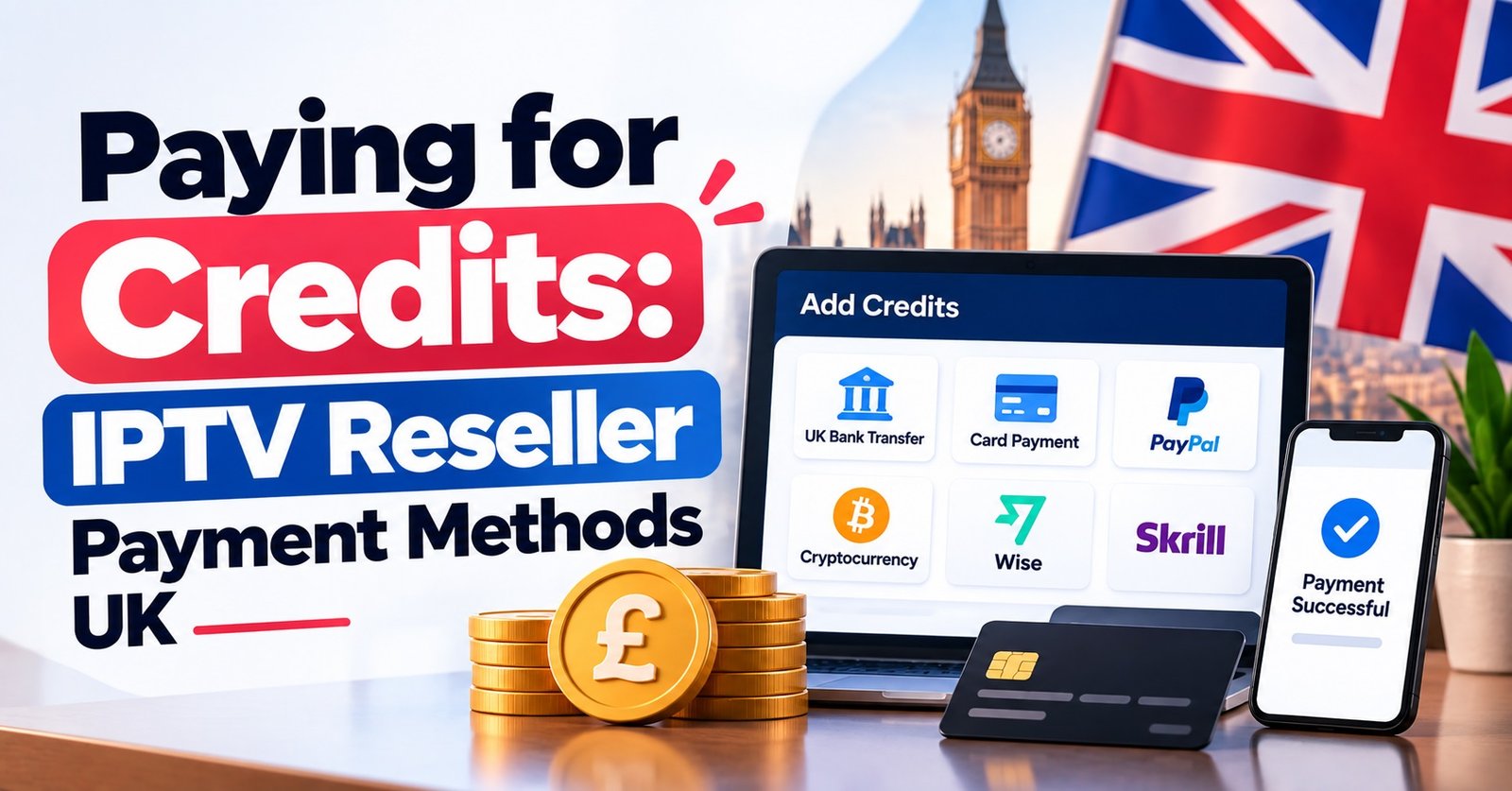
The IPTV Reseller Payment Methods UK providers commonly accept are debit and credit cards, bank transfer over Faster Payments, and, less often, digital wallets or cryptocurrency. When you are buying credits, a card payment or a transfer to a named UK business account is usually the sensible choice, because both leave a clear record and give you some route back if the arrangement goes wrong. Crypto and requests to “send it as a personal payment” give you very little.
Before choosing, separate two money flows that people often treat as one: what you pay your provider for credits, and what your subscribers pay you. They carry different risks. A problem with a credit purchase can wipe out a balance you have already built your month around, while a disputed subscriber payment can leave you out of pocket for a line you have already activated. Getting both sides right comes down to records and recourse far more than finding a single “best” method.
Paying Your Provider: How Each Method Holds Up
When you top up a IPTV reseller panel, the question worth asking is simple: if the credits never arrive, or the provider disappears, what can you actually fall back on? The answer differs a lot by method.
| Method | What you can fall back on | What to watch |
|---|---|---|
| Credit card | Chargeback, plus Section 75 on eligible personal card purchases | Business cards and purchases under £100 usually fall outside Section 75 |
| Debit card | Chargeback through your bank under card scheme rules | Not a legal right; time limits and evidence matter |
| Bank transfer | Name check on new payees, plus APP scam reimbursement for eligible customers | Covers scams, not ordinary disputes with a genuine business |
| Digital wallet | The wallet’s own buyer protection terms | Protection usually disappears on personal or gift payments |
| Cryptocurrency | Very little in practice | Irreversible, and generally outside UK compensation schemes |
Card payments give the broadest safety net. Section 75 of the Consumer Credit Act makes the card issuer jointly liable on single purchases between £100 and £30,000 on personal credit cards, and chargebacks cover both credit and debit cards where goods or services were not delivered. The catch for resellers is that many small top-ups fall below the Section 75 threshold, and a business credit card is not normally covered by it at all.
Bank transfer has become safer than it used to be. Since 7 October 2024, payment firms in the Faster Payments scheme have had to reimburse eligible victims of authorised push payment scams, up to £85,000 per claim, with claims allowed up to 13 months after the final payment. Eligibility covers consumers, micro-enterprises and charities, so a small reseller business may qualify, but the rules exist for scams. If you pay a real company and later fall out over service quality, that is a civil dispute, not a reimbursement claim. The regime is also under formal review in 2026, with the Payment Systems Regulator being folded into the FCA, so ask your own bank how it applies before relying on it.
Pro tip: Treat a Confirmation of Payee mismatch as a stop sign, not a formality. If the name your bank shows does not match the business you think you are paying, pause and verify through a channel you already trust before sending anything.
The provider’s side of the checkout is worth reading too. Looking at how a provider presents its reseller credit packages and top-up tiers tells you what you are buying per credit, which makes it easier to judge whether a payment receipt later matches what landed in your panel.

A Payment Method Is Not a Licence Check
A tidy checkout with familiar card logos tells you the provider holds a merchant account. It does not tell you whether the service holds the rights and permissions it needs. IPTV is simply a delivery technology, and whether the content behind it is lawful depends on licensing agreements and local requirements, not on how the invoice was paid.
This matters to IPTV panel resellers in a practical way. Card processors and wallet providers run acceptable-use policies, and accounts that break them can be restricted or closed with little notice. If your provider’s payment account is frozen, top-ups stall, and your own renewals follow. A provider that only accepts crypto is not automatically doing anything wrong, but it is fair to ask why it cannot keep a mainstream merchant account, and to weigh the answer before trusting it with a large balance.
Choosing IPTV Reseller Payment Methods UK Customers Will Actually Use
On the subscriber side, most UK buyers expect to pay by card or bank transfer, and anything more unusual adds friction at the point of sale. The method you offer shapes how many people complete a purchase, how many renew without chasing, and how many disputes you handle each month.
Card payments through a hosted payment link are the smoothest for customers and the easiest to reconcile, because each payment arrives with a name, amount and timestamp. Bank transfer works well for repeat customers who know you, provided you give them a unique reference to include so you can match the money to the right line. Sending bare account details with no reference is how payments end up sitting unmatched for days.
Timing is where resellers lose money. Once you create a full line, the credit is consumed, and a provider will rarely return it because your customer later reversed their payment. Activating a paid line only after the funds have actually cleared protects you. Where a customer wants to try the service first, trial lines that do not use up credits are a far better tool than activating a paid line on trust.
Recurring payments versus manual renewals
Recurring card billing cuts down on renewal chasing, but it raises the stakes on transparency. A customer who forgets they signed up for automatic renewal is more likely to dispute the charge than contact you. If you use recurring billing, send a reminder before each renewal and make cancellation easy. Manual renewals take more admin but produce fewer surprise disputes, which suits smaller resellers who deal with customers directly.
Why personal payment requests backfire
Some resellers ask customers to send wallet payments marked as personal or “friends and family” to avoid fees. It saves a small percentage and costs a lot more in the long run. It usually breaches the wallet’s terms for commercial sales, strips the customer of buyer protection, and makes your business look like something to be wary of. Paying the processing fee and pricing it into your subscription is the cleaner route.
Keeping a Paper Trail That Matches Your Panel
Payment disputes are won or lost on records. Every credit top-up should have a matching receipt or invoice showing the date, amount and number of credits bought. Every subscriber payment should link to a specific line, with the date it was activated and the period it covers.
The quickest way to keep this tidy is to reconcile against your panel rather than your memory. A IPTV reseller dashboard with a full credit transaction log lets you check when credits were added, which lines they went to and what balance remains, so a mismatch shows up in minutes rather than at the end of the month. If a customer disputes a charge, being able to show the payment, the activation date and the credit used puts you in a much stronger position with the card issuer.
There is a tax side as well. HMRC expects businesses to keep financial records for several years, and payment receipts and invoices are part of that. Keeping everything in one place from the start avoids a painful reconstruction later.
Pro tip: Once a payment clears, send the customer their setup details and a link to a guide on choosing an IPTV app for Android TV in the same message. A customer who is up and running within minutes is far less likely to dispute the payment.
What a Well-Run Checkout Looks Like From the Reseller Side
When you are weighing up a provider, the payment process gives away a surprising amount about how the business is run.
Reassuring signs include an invoice or receipt that names the business, a payee name that passes the bank’s name check, written terms explaining what happens to unused credits, and a stated timeframe for credits appearing after payment.
Signs that deserve a pause include pressure to pay by crypto or gift card, discounts offered only for untraceable methods, no written refund or credit terms, and bank details that change halfway through a conversation.
That last one deserves its own warning. Messages claiming “our account has changed, pay this one instead” are a common route for payment redirection fraud, whether the message comes from the provider or from someone impersonating them.
Pro tip: If bank details change by message, confirm them through a contact method you used before the change, never by replying to the message that announced it.
Questions Resellers Ask About Payments
Can I get a refund on credits if I paid by card and changed my mind?
A chargeback is designed for services that were not provided or were not as described, not for a change of mind. Whether unused credits are refundable depends on the provider’s own terms, so read them before topping up rather than after.
Does paying by bank transfer leave me with no protection?
Not entirely. The name check on new payees helps you avoid paying the wrong account, and eligible customers can claim reimbursement if they were tricked by a scammer. What it will not cover is a normal disagreement with a genuine business, which is where cards have the edge.
Should I accept cryptocurrency from my own subscribers?
You can, but think about what it does to your business. Payments cannot be reversed in either direction, prices fluctuate between quote and payment, and record-keeping gets harder. Most UK subscribers expect card or bank transfer, so crypto rarely brings in customers you would not have reached anyway.
Does Section 75 apply when I buy credits for my business?
Section 75 is built around personal credit agreements. Credits bought on a business card, or in top-ups under £100, generally fall outside it. A chargeback may still be available, so keep your receipts either way.
What happens to my customers if my provider’s payment account is frozen?
New top-ups stop until the provider sorts it out, which can leave you unable to renew lines. Holding a modest credit buffer, and knowing whether your provider’s credits expire, gives you breathing room while you find out what is going on.
Getting the Money Side Right
There is no single winner among the IPTV Reseller Payment Methods UK IPTV resellers deal with. For paying your provider, cards give the widest recourse and bank transfer to a verified business account is a reasonable alternative, while crypto and personal wallet payments leave you exposed. For your own subscribers, offer the methods they already trust, activate paid lines only once funds clear, and keep records that line up with your panel. Protection schemes have limits and are being reviewed, so confirm the details with your bank, read your provider’s credit terms, and make those two checks part of every first purchase.
Reseller Checklist Before Your Next Credit Top-Up
- Read the provider’s written terms on unused credits and refunds
- Check that the payee name passes your bank’s name check
- Save the invoice showing the date, amount and credit quantity
- Confirm the credits appear in your panel and match the receipt
- Verify any changed bank details through a contact you already trust
- Keep enough credit in reserve to cover renewals due this month
[…] small IPTV panel reseller books are built from the same four streams. If these are clean, the rest is mostly […]