


IPTV Reseller Expiry Tracking is the habit of knowing, at any moment, which customer lines expire in the next fortnight and which of those customers have already been contacted. Your panel stores the expiry date on every line, so the raw data is already there. What the panel does not do is tell you who to message on Tuesday morning, or flag the customer whose line quietly ran out nine days ago while you were busy activating new orders.
That distinction is where most reseller operations leak money. A line expires, the customer loses service, and instead of asking why, they simply try somebody else’s trial. There is no complaint and no refund request, so nothing appears in your logs except a subscription that stopped. The fix is not complicated software. It is a repeatable routine that turns expiry dates into a short daily list you actually look at.
Why the User List in Your Panel Is Not a Tracking System
Open your reseller dashboard and sort by expiry date. You now have a snapshot of every active line ordered by when it ends. Useful, but it answers only one question: who expires soon. It cannot tell you whether you already messaged that person, whether they said they would pay on Friday, whether they have two lines running on different dates, or whether they churned three months ago and this is a dormant record.
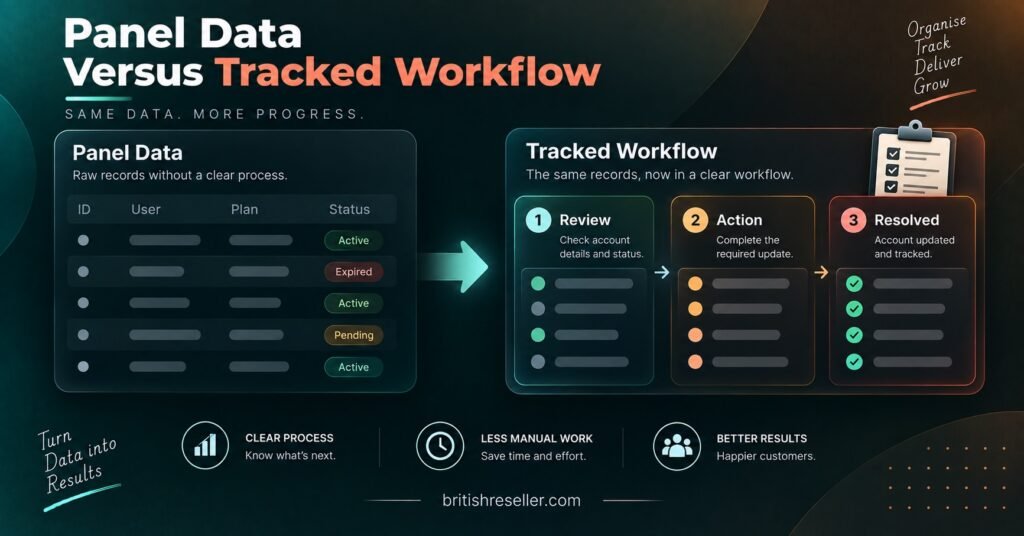
A panel view is a database query. Tracking is a workflow with state attached to it. The gap between the two is the reason resellers with forty customers feel in control and resellers with two hundred feel permanently behind, even when both are using the same dashboard and the same IPTV reseller panel tools and expiry controls.
There is a second problem with relying on the sorted list alone. It only shows what is live right now. Once a line lapses and disappears from your active view, the customer disappears from your thinking too. A useful tracking method deliberately keeps recently expired customers visible for a while, because that is the window where a short, non pushy message still works.
Three Points on the Timeline That Matter More Than the Expiry Date
The expiry date itself is the least actionable date in the whole cycle. By the time it arrives, the decision has usually been made. Three other moments do the real work.
Ten to fourteen days out
This is where you find out whether the customer intends to continue. Far enough ahead that the message reads as a courtesy rather than a demand, and close enough that they can actually picture the service ending. It also gives you time to top up credits if a cluster of renewals is landing in the same week.
Forty-eight to seventy-two hours out
The reminder that converts. A short, factual note stating the exact date and time the line ends. No pitch, no discount, no urgency language. Customers who were always going to renew often just needed the date in front of them.
Three to seven days after expiry
The window everyone ignores. A customer whose line stopped on Monday is usually still on the same device, still has the app installed, and has not yet committed to anyone else. One plain message asking whether they want it restored recovers a meaningful share of the people you would otherwise have written off. After a fortnight, it starts to feel like chasing.
Pro tip: Record the date you contacted a customer, not just the date their line expires. Without it, you will either message the same person three times or forget them entirely, and both cost you the sale.
Building an IPTV Reseller Expiry Tracking System You Will Actually Maintain
The best system is the one you still use in six months. That usually means fewer fields, not more. A spreadsheet with six columns that gets updated every day beats a proper CRM that nobody opens after week three.
Here is the minimum that earns its place:
| What to record | Why it earns its place |
|---|---|
| Customer name and contact method | You will not message anyone if you have to hunt for their WhatsApp number |
| Username or line reference | Lets you find and extend the line in the panel without guessing |
| Expiry date and duration purchased | Duration tells you the customer’s habit, not just the deadline |
| Date of last reminder sent | Stops double messaging and tells you where each person sits in the sequence |
| Renewal status | Three values are enough: pending, confirmed, lapsed |
| Notes | Payment quirks, device issues, promises to pay on a certain date |
Anything beyond this is optional. Resist the urge to track revenue per customer, lifetime value, or acquisition source in the same sheet. Those are reporting questions. Mixing them into an operational list makes the list slower to update, and a list that is slow to update becomes a list that is out of date.
For the tooling itself, a shared spreadsheet handles a customer base of a few dozen comfortably. A lightweight CRM or a simple database starts paying for itself when you are juggling multiple durations, sub-resellers, and more customers than you can hold in your head. The panel remains the source of truth for what is actually live; your tracker is the source of truth for what you have done about it.

Where Manual Tracking Quietly Falls Apart
Manual tracking does not fail dramatically. It degrades. Four situations cause most of it.
Mixed durations are the first. When every customer buys twelve months, your renewals cluster predictably and you can almost work from memory. Once you have monthly, quarterly, six month and annual lines running together, expiry dates scatter across the calendar and the mental model breaks. This is usually the point at which a UK IPTV reseller first misses a renewal without noticing.
Multi-line customers are the second. A household with three lines bought at different times looks like three separate rows in your tracker and one relationship in real life. Message them three times in a fortnight and you look disorganised. Group lines by customer, not by line, and renew them onto a shared date where the customer agrees to it.
Sub-reseller blind spots are the third. If you have accounts beneath you, their customers’ expiry dates are their responsibility, but their credit consumption is your forecast. You do not need visibility of their individual subscribers. You do need to know roughly when their renewal volume peaks, or their bulk top-up request will arrive at the worst possible moment.
The fourth is simply holidays and illness. A tracking routine that lives only in one person’s head stops entirely the week that person is away. Writing the routine down, even as five lines in a shared document, is what makes it a system rather than a habit.
The Weekly Review That Keeps It Honest
Daily checks handle the urgent. A short weekly review catches what daily checks miss. Fifteen minutes, same time each week:
- Pull the panel’s active line list and compare the count against your tracker’s active count, then investigate any difference
- Scan for lines expiring in the next fortnight that have no reminder date logged
- Review anyone marked lapsed in the last seven days and decide whether to send a single recovery message
- Check for duplicate or test lines still sitting active and consuming nothing but confusion
- Look at the next month’s renewal volume and note whether your credit balance covers it
That last point is worth taking seriously. Renewals arrive in clusters because sign-ups arrived in clusters, and running short of credits during a busy renewal week turns an admin problem into a service failure your customer experiences directly. Checking current IPTV reseller credit packages against next month’s expiry calendar takes a minute and removes the scramble.
Pro tip: Keep a small credit buffer sized to your busiest historical renewal week rather than your average one. Averages are fine for accounting and useless for planning.
What to Put in the Reminder Itself
Message content matters less than timing, but it is not irrelevant. The reminders that work tend to share three qualities: they state the exact expiry date, they say what the customer needs to do in one sentence, and they do not sell anything.
Avoid discount offers in the first reminder. Once customers learn that waiting produces a price drop, waiting becomes the behaviour you have trained. Keep pricing consistent and let the service reliability do the persuading.
Avoid automated-sounding templates in the recovery message after a lapse. At that stage the customer has already experienced an interruption, and a clearly automated message reads as indifference. A short human line asking if they want it restored performs better than anything with a subject line.
One more practical detail. Confirm the extension in writing once payment clears, with the new expiry date stated plainly. It closes the loop, it gives the customer a reference, and it means the next reminder does not arrive as a surprise.
Handling the Awkward Cases
Some customers renew three days late every single time. Rather than treating this as a failure each cycle, mark their expected pattern in your notes and adjust your reminder timing for them specifically. You are managing a person, not a data field.
Some customers go completely silent. Two messages and no reply means stop. Continuing past that damages your reputation more than the renewal is worth, and the customer who ignored you in March sometimes returns in September if you did not pester them in between.
Some lines expire while a technical issue is unresolved. Do not chase a renewal from someone who is waiting on a fix. Sort the problem, confirm it is working, then raise renewal separately. Getting that order wrong is how a solvable support ticket becomes a permanent loss.
Newer resellers sometimes find the underlying mechanics confusing before the tracking question even arises, in which case working through a general guide to how reseller panels and credits operate first will make the expiry workflow much easier to design.
Pro tip: Before extending a line as a goodwill gesture, note it in your tracker with a reason. Undocumented free extensions have a habit of becoming an expectation.
Frequently Asked Questions
How far ahead should I start tracking a customer’s expiry?
From the day you create the line. Add the expiry date to your tracker at activation rather than trying to reconstruct the list later. Reconstruction is where lines get missed.
Does the reseller panel not handle this automatically?
The panel stores and displays expiry dates, and most will let you sort or filter by them. What it does not do is track your side of the conversation, which is the half that determines whether the renewal happens.
Should I extend a line before the customer has paid?
Only for customers with an established payment history, and only when you have recorded it. Doing it casually for everyone turns your credit balance into an unsecured loan book.
How do I handle a customer with several lines expiring on different dates?
Group them under one customer record and offer to align the dates at the next renewal. One conversation instead of three, and a cleaner calendar for you.
What about expiry dates for sub-reseller customers?
Those belong to the sub-reseller. Track their aggregate credit consumption and renewal peaks instead, so you can anticipate top-up requests rather than react to them.
Where This Leaves You
Good IPTV Reseller Panel Expiry Tracking is not a product you buy. It is a short list you maintain, a fixed weekly review, and reminders sent at three points rather than one. The panel supplies the dates. You supply the follow-up, and the follow-up is what customers actually experience.
Two limitations are worth accepting honestly. Tracking cannot rescue a customer who left because the service was unreliable, and no reminder sequence recovers everyone. What it does reliably prevent is the avoidable loss: the customer who would have renewed, would have paid the same price, and simply was not asked in time.
Start with the six columns above and this week’s expiring lines. Build the rest once the daily habit sticks.